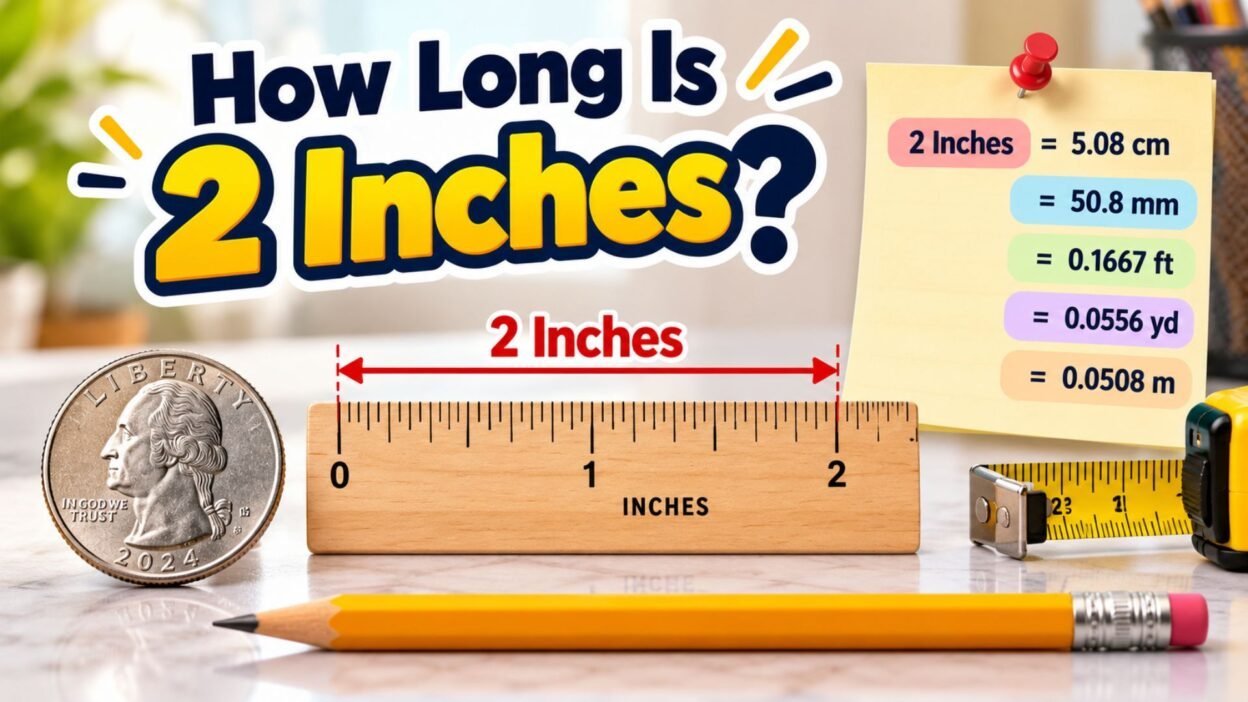
Two inches is a short length equal to 5.08 centimeters, 50.8 millimeters, or 0.1667 feet. It is about the width of two adult fingers placed side by side, although actual finger widths vary from person to person.
If you need to picture how long 2 inches is without a ruler, everyday objects can help you estimate the distance. You can also convert the measurement into centimeters or millimeters when working on a DIY project, measuring an object, or following instructions.
How Long Is 2 Inches Exactly?
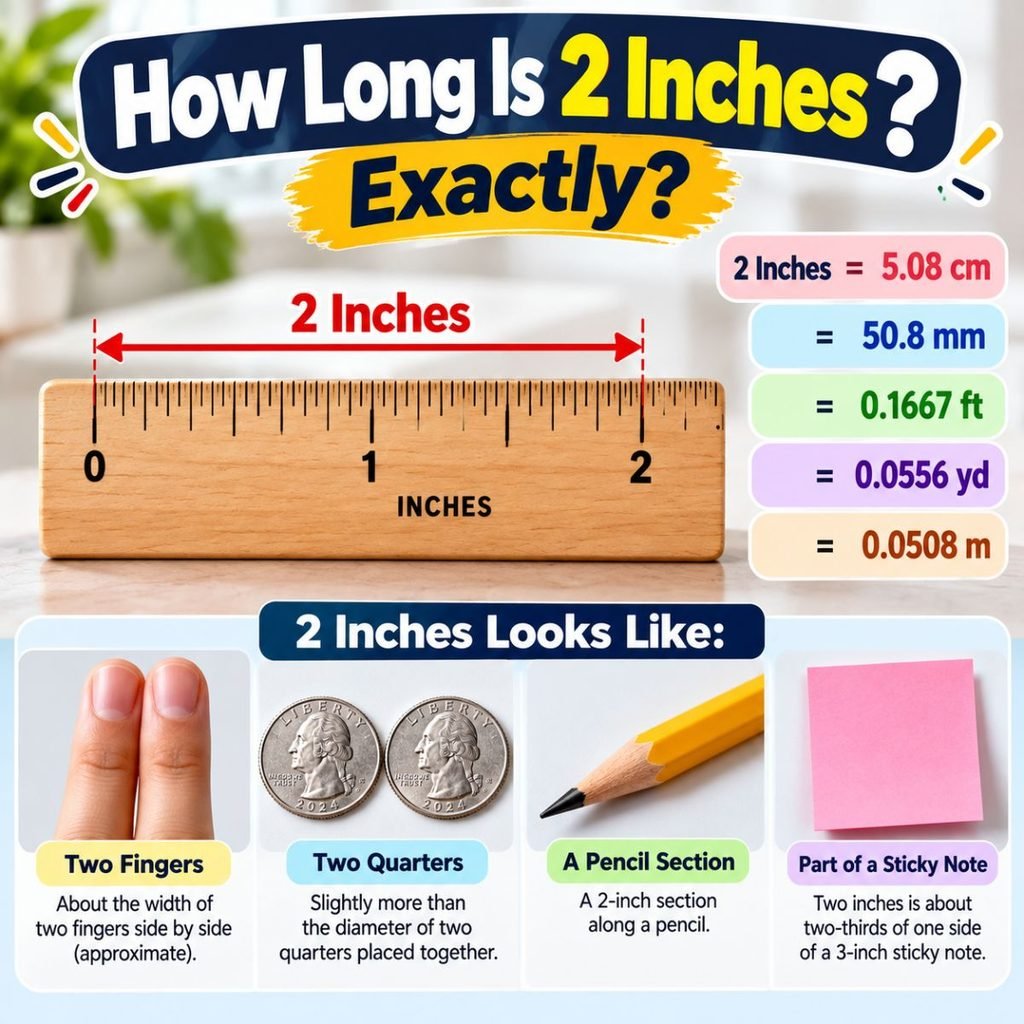
Two measures 2 inches from one end to the other in a straight line. An inch is a standard unit of length used in the United States and several other countries, especially for everyday measurements.
The inch is defined exactly as 25.4 millimeters. Therefore, the conversion for is:
- Inches: 2 in
- Centimeters: 5.08 cm
- Millimeters: 50.8 mm
- Feet: 0.1667 ft (approximately)
- Yards: 0.0556 yd (approximately)
- Meters: 0.0508 m
How to Calculate 2 Inches in Centimeters
To convert to centimeters, multiply the number of inches by 2.54.
Formula:
Centimeters = Inches × 2.54
Calculation:
2 × 2.54 = 5.08 cm
Final answer: equals exactly 5.08 centimeters.
What Does 2 Inches Look Like?
Two inches can be easier to understand when you compare it with familiar objects. These comparisons help you estimate the length when you do not have a measuring tool nearby.

1. Two adult fingers side by side
Two fingers placed next to each other can provide a rough visual reference for . However, finger widths differ, so this is only an estimate.

2. A US quarter coin
A US quarter has a diameter of about 0.955 inches. Two inches is slightly more than the diameter of two quarters placed side by side.

3. A section of a pencil
Imagine marking a 2-inch section along a pencil. The marked portion would be 5.08 centimeters long, regardless of the pencil’s overall length.

4. A small section of a sticky note
On a standard 3-by-3-inch sticky note, a 2-inch line would cover two-thirds of one side.
These examples are useful for estimating length, but they should not replace a ruler when accurate measurements are important.
How Long Is 2 Inches on a Ruler?
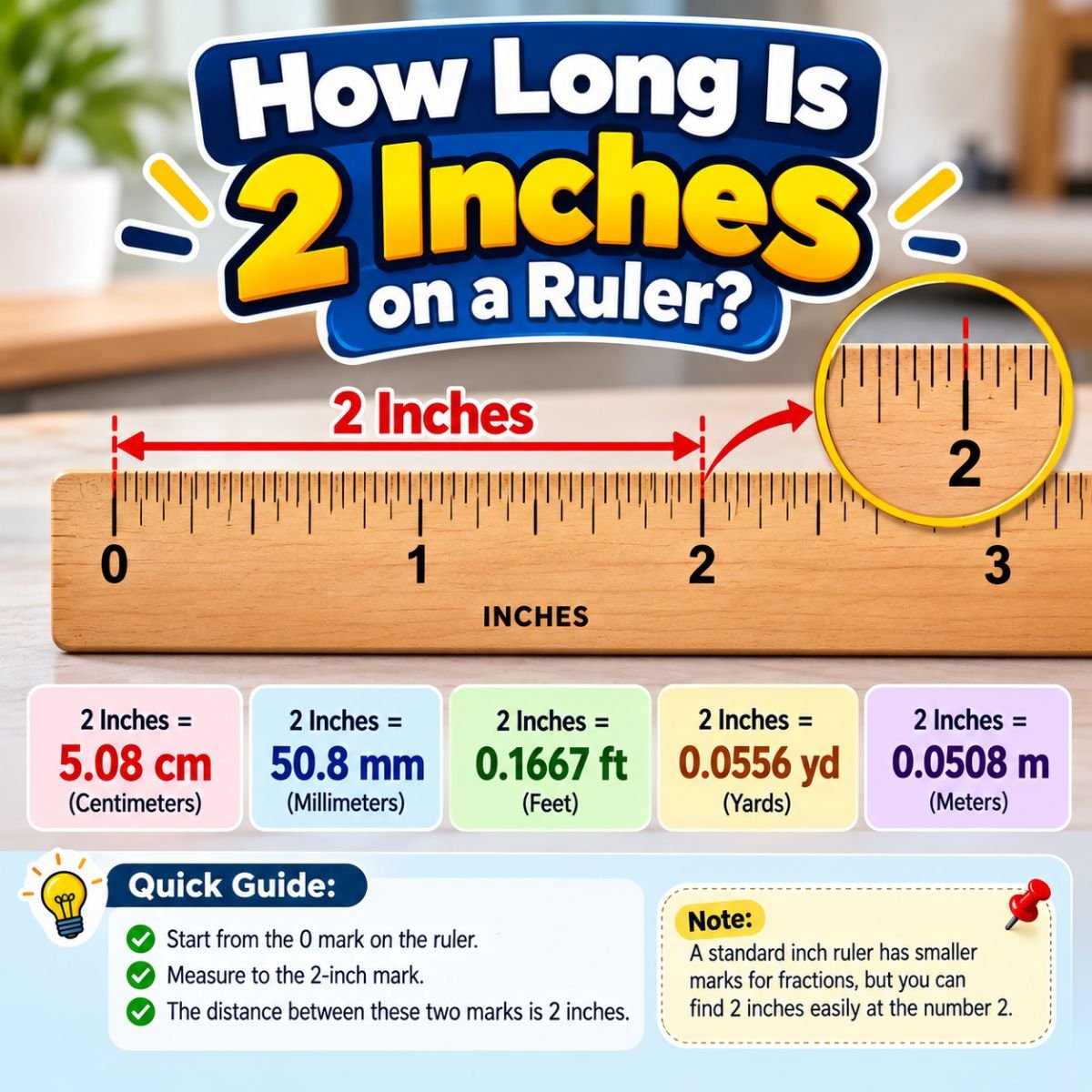
On a standard inch ruler, 2 inches is the distance between the 0-inch mark and the -inch mark.
The highlighted distance runs from 0 to . The drawing is illustrative, not a print-to-scale ruler.
A ruler divides each inch into smaller fractions, such as halves, quarters, eighths, and sixteenths. For a measurement of exactly , you do not need to count the smaller marks; simply locate the -inch line.
If your ruler displays centimeters instead, look for the 5.08 cm position. On a ruler marked only in whole millimeters, the same length is 50.8 mm, so it falls between 50 mm and 51 mm.
2 Inches to Other Measurements
Use this conversion table to find the equivalent of 2 inches in common units of length.
| Unit | Equivalent |
|---|---|
| Inches | 2 in |
| Centimeters | 5.08 cm |
| Millimeters | 50.8 mm |
| Meters | 0.0508 m |
| Feet | 0.1667 ft |
| Yards | 0.0556 yd |
| Micrometers | 50,800 µm |
The metric conversions are exact when using the standard definition of an inch. The feet and yards values shown are rounded.
How Long Is 2 Inches in Millimeters?
Two inches equals 50.8 millimeters.
To convert inches to millimeters, multiply by 25.4.
2 × 25.4 = 50.8 mm
This conversion is particularly useful for small parts, hardware, crafting, and technical measurements.
How Long Is 2 Inches in Feet?
Two inches equals approximately 0.1667 feet.
Since 12 inches equal 1 foot, divide by 12:
2 ÷ 12 = 0.1667 feet (approximately)
This is one-sixth of a foot.
How Long Is 2 Inches in Meters?
Two inches equals 0.0508 meters.
To calculate the result, multiply the inch measurement by 0.0254:
2 × 0.0254 = 0.0508 m
Because a meter is much larger than an inch, the decimal value is less than one-tenth of a meter.
Common Uses of a 2-Inch Measurement
A 2-inch length appears in many everyday situations. Understanding the measurement can help you estimate sizes before using a ruler or tape measure.
- Home improvement: Checking the length of a small piece of trim, a gap, or a component.
- Crafting: Measuring ribbon, paper, fabric, or other small materials.
- Sewing: Marking a short seam allowance or a section of fabric, depending on the pattern.
- DIY projects: Measuring small wooden pieces, fittings, or hardware.
- Schoolwork: Practicing conversions between customary and metric units.
- Product dimensions: Understanding the length of small accessories or components listed in inches.
Remember that a measurement of describes length, not area. A square that measures 2 inches on each side has an area of 4 square while a line measuring is simply long.
Frequently Asked Questions
Is 2 inches considered long or short?
Two inches is generally considered a short length. It equals 5.08 centimeters and is useful for measuring small objects, short gaps, and compact components.
Is 2 inches the same as 5 centimeters?
Not exactly. Two inches equals 5.08 centimeters, which is 0.08 centimeters longer than 5 centimeters. The two measurements may be treated as approximately equal for rough estimates, but not when precision matters.
How can I measure 2 inches without a ruler?
You can estimate the length using a familiar object, such as the width of your fingers, or mark a 2-inch distance on paper using a ruler when one becomes available. Hand measurements vary, so avoid relying on them for precise work.
How many millimeters are in 2 inches?
There are exactly 50.8 millimeters in . Multiply the inch value by 25.4 to convert inches to millimeters.
What is half of 2 inches?
Half of is 1 inch, equal to 2.54 centimeters or 25.4 millimeters.
How many centimeters are in 2 inches?
Two inches equals exactly 5.08 centimeters. The calculation is 2 × 2.54 = 5.08 cm.
Conclusion
Two inches is a length of 5.08 centimeters or 50.8 millimeters. You can locate it on a ruler by measuring from the zero mark to the 2-inch mark, or estimate it using everyday objects when precision is not essential.
For accurate construction, crafting, or technical work, use a ruler or tape measure rather than relying on visual comparisons.