Have you ever wondered how light one gram really is? A gram is a small unit of mass, so small that many everyday objects weigh several grams without looking particularly heavy. Understanding what weighs a gram can help you estimate small quantities, compare objects, and get a better feel for metric measurements.
The easiest way to understand one gram is to compare it with familiar items. A small paper clip, a dollar bill, or a few grains of a substance can help you visualize this tiny amount, although their actual weights vary. For precise measurements, a digital scale is the most reliable option.
In this guide, you will discover everyday objects that weigh approximately one gram, learn how grams compare with ounces and milligrams, and explore practical ways to estimate small weights. You will also find useful examples, a quick-reference table, and answers to common questions about measuring one gram.
What Weighs a Gram?
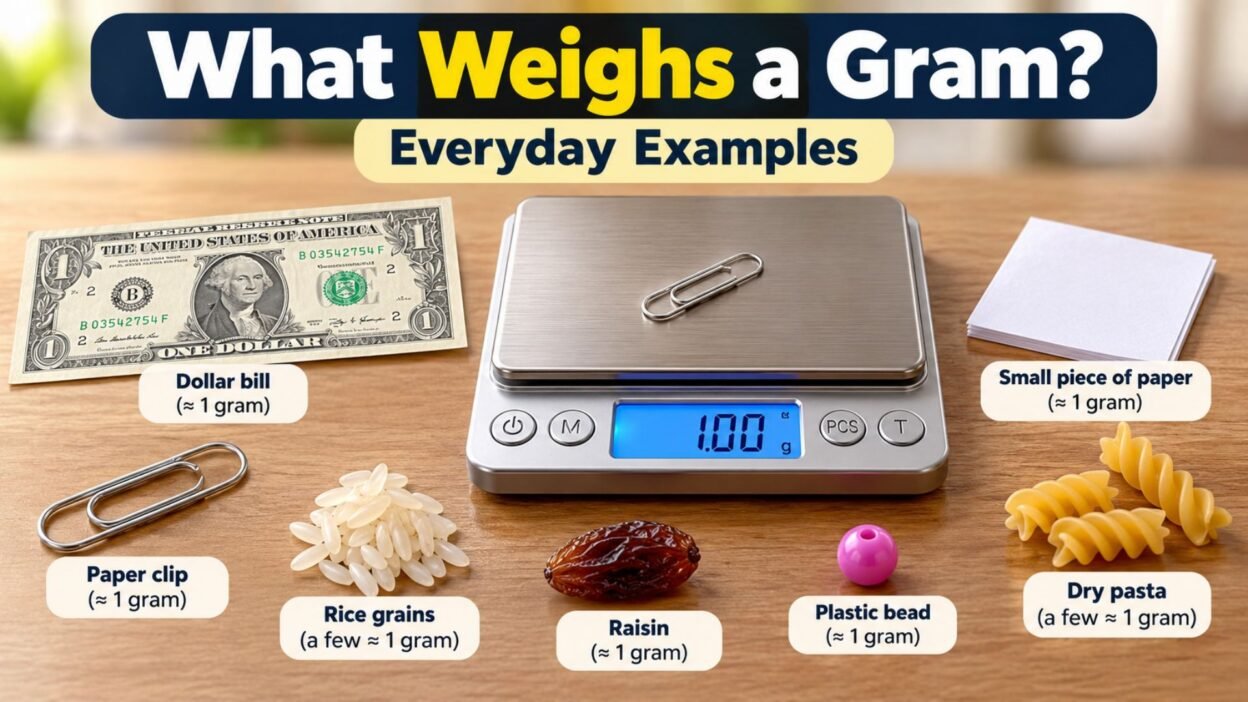
One gram (1 g) is a metric unit of mass equal to one-thousandth of a kilogram. It is approximately the mass of a small paper clip, depending on its size and design.
Here are some familiar examples of objects that may weigh around one gram:
- A small metal paper clip
- A standard US dollar bill, which weighs approximately one gram
- A small pinch of lightweight material
- A few small pieces of dry food, depending on their size
- A tiny plastic component
- A small bead or craft item
- A single lightweight piece of paper cut to a suitable size
These are estimates, not universal standards. Materials, dimensions, moisture content, and manufacturing differences can all affect an object’s mass.
If you need to measure exactly one gram, use a digital scale with sufficient precision rather than relying on appearance alone.
15 Everyday Things That Weigh About a Gram
Many familiar objects can help you visualize one gram. However, their actual mass depends on their size, material, and design. The examples below distinguish reliable reference points from items that are only rough estimates.

1. A Small Paper Clip
A small metal paper clip is a familiar reference for approximately one gram. Some ordinary clips weigh closer to half a gram, while larger ones may weigh around one gram or more.
OpenStax
+1
Best for: Classroom demonstrations and visualizing small masses.

2. A US Dollar Bill
A US Federal Reserve note weighs approximately one gram, regardless of its denomination. This makes a banknote one of the most useful everyday references for understanding the measurement.
U.S. Currency Education Program
+1
Best for: Estimating small masses without a scale.

3. A Dry Lentil
A single dry lentil weighs much less than one gram. Several lentils together may approach one gram, depending on their variety and size.
Best for: Demonstrating how multiple small food items combine to make a measurable mass.

4. A Small Plastic Bead
Lightweight craft beads can weigh a fraction of a gram each. A sufficiently large bead or a small group of beads may weigh approximately one gram.
Best for: Craft projects and elementary measurement activities.

5. A Small Raisin
Raisins vary considerably in size and moisture content. A small raisin may weigh around a gram, but larger raisins can weigh several grams.
Best for: Comparing the mass of small food portions.

6. A Small Piece of Paper
A tiny paper scrap can weigh around one gram if it has the appropriate dimensions and thickness. A standard sheet of office paper usually weighs several grams, so the entire sheet is not a one-gram reference.
Best for: Understanding how paper size and thickness affect mass.

7. Several Straight Pins
Sewing pins are lightweight metal objects. A single pin usually weighs considerably less than one gram, but several pins together can approach that amount. The exact number depends on their length and construction.
Best for: Comparing individual items with a combined mass.

8. A Lightweight Button
Small plastic buttons may weigh less than one gram. Larger buttons, wooden buttons, and metal buttons can be heavier.
Best for: Household measurement activities.

9. A Few Grains of Uncooked Rice
One grain of uncooked rice weighs far less than a gram. A small collection of grains can add up to one gram, although the count varies with rice variety and grain size.
Best for: Learning how tiny individual masses add together.

10. A Small Craft Pom-Pom
Small yarn or fiber pom-poms can weigh around a gram or less. Their mass depends on the amount and type of material used.
Best for: Simple classroom and craft experiments.

11. A Tiny Plastic Toy Part
Small plastic components can weigh approximately one gram, especially when they are thin and compact. Larger or solid components may weigh considerably more.
Best for: Demonstrating mass in manufactured objects.

12. A Small Piece of Craft Foam
A small piece of foam may weigh less than one gram. A larger piece may approach one gram depending on its density and dimensions.
Best for: Comparing materials that have different densities.

13. A Small Dry Seed
Seeds come in many shapes and sizes. A small seed generally weighs much less than one gram, but a larger seed or several small seeds can provide a useful comparison.
Best for: Science projects involving natural materials.

14. A Tiny Jewelry Charm
Small charms made from thin metal or lightweight materials may weigh around one gram. Solid silver, stainless steel, or other dense metal charms can weigh more.
Best for: Comparing the mass of small accessories.

15. A Small Piece of Dry Pasta
A single small piece of dry pasta typically weighs less than one gram, although the exact amount depends on its shape and size. Several pieces can add up to one gram.
Best for: Everyday food measurement comparisons.
Important: The US dollar bill and a paper clip are the most practical starting points on this list. The other objects are examples of items that may weigh around one gram or can be combined to reach that mass. They should not be treated as exact standards.
Quick Reference Table: Objects That Weigh About 1 Gram
| Everyday item | Approximate mass | How reliable is it as a reference? |
|---|---|---|
| US dollar bill | 1 g | Very good |
| Small paper clip | About 0.5–1 g or more | Good, depending on size |
| Small raisin | Around 1 g for some sizes | Variable |
| Plastic bead | Depends on size | Variable |
| Small paper scrap | Depends on dimensions | Variable |
| Sewing pins | Usually less than 1 g each | Better in groups |
| Rice grains | Much less than 1 g each | Better in groups |
| Small dry seeds | Usually less than 1 g each | Variable |
| Craft foam | Depends on size and density | Variable |
| Dry pasta | Usually less than 1 g per small piece | Variable |
The table provides practical comparisons rather than certified weights. If a particular object needs to weigh exactly one gram, measure it with a suitable scale.
How Much Is 1 Gram in Other Units?
A gram is part of the metric system, but you may encounter other units when reading recipes, product specifications, jewelry descriptions, or scientific information.
According to the National Institute of Standards and Technology (NIST), one gram equals exactly 0.001 kilogram and approximately 0.035 ounce.
NIST
+1
| Unit | Equivalent of 1 gram |
|---|---|
| Milligrams (mg) | 1,000 mg |
| Grams (g) | 1 g |
| Kilograms (kg) | 0.001 kg |
| Ounces (oz) | Approximately 0.0353 oz |
| Pounds (lb) | Approximately 0.00220 lb |
How Many Milligrams Are in a Gram?
There are exactly 1,000 milligrams in one gram.
Formula:
\[ \text{Milligrams}=\text{Grams}\times1,000 \]
For example, to convert 3 grams into milligrams:
\[ 3\times1,000=3,000\text{ mg} \]
Therefore, 3 grams equals 3,000 milligrams.
How Many Grams Are in a Kilogram?
One kilogram equals exactly 1,000 grams. To convert grams into kilograms, divide the number of grams by 1,000.
NIST
+1
For example:
\[ 500\div1,000=0.5\text{ kg} \]
Therefore, 500 grams equals 0.5 kilograms.
How Many Ounces Are in a Gram?
One gram equals approximately 0.0353 avoirdupois ounces, the ounces commonly used for everyday goods in the United States.
To convert grams into ounces, multiply by approximately 0.0353.
For example:
\[ 10\times0.0353\approx0.353\text{ oz} \]
So, 10 grams is approximately 0.353 ounces.
What Does 1 Gram Look Like on a Digital Scale?

A digital scale makes the idea of one gram much easier to understand. Instead of estimating by appearance, you can place an object on the weighing platform and read its mass.
Follow these steps to measure one gram:
- Place the scale on a firm, level surface.
- Switch it on and select grams (g) if the unit setting is available.
- Wait for the display to settle.
- Place the object carefully in the center of the platform.
- Read the displayed value.
- If necessary, use the tare function to subtract the mass of an empty container.
A scale displaying 1.00 g shows two decimal places, but that alone does not guarantee accuracy. The scale’s resolution, calibration, and measurement conditions also matter.
For small quantities, choose a scale designed to measure them reliably. A kitchen scale intended for larger food portions may not distinguish one gram as accurately as a suitable precision scale.
How Can You Measure One Gram Without a Scale?
You can estimate one gram by comparing an object with something whose mass is known. However, these methods provide approximations rather than exact measurements.
1. Use a US Dollar Bill
If you have a US banknote, it provides a useful reference because its approximate mass is one gram. Compare the size and feel of another lightweight item with the note, keeping in mind that touch alone cannot confirm equal mass.
U.S. Currency Education Program
+1
2. Compare Small Paper Clips
A paper clip can help you develop a rough sense of a gram. However, clip sizes differ, so do not assume every paper clip weighs exactly one gram.
3. Combine Several Small Objects
You can place several rice grains, seeds, or lightweight craft pieces together to approach one gram. The total depends on the number, size, and material of the objects.
4. Use a Balance
A simple balance compares the mass of two objects. If you have a verified one-gram reference mass, a balance can help determine whether another object has a similar mass.
Do not use an ordinary coin as an assumed one-gram standard. Coins vary by country, denomination, and design, and their masses are often several grams.
Safety note: Never estimate medication doses, chemical quantities, or other safety-critical measurements by sight or touch. Use an appropriate calibrated instrument.
What Commonly Weighs Less Than One Gram?
Understanding what weighs less than a gram is just as helpful as knowing what weighs approximately one gram.
Examples include:
- A single grain of rice
- A small sewing pin
- A tiny plastic bead
- A small seed
- A short piece of thread
- A small scrap of lightweight paper
- A single small piece of dry pasta
The exact mass of each item depends on its dimensions and composition. Many of these objects weigh only a fraction of one gram.
For example, if an item weighs 0.25 grams, four identical items would have a combined mass of approximately one gram:
\[ 4\times0.25=1\text{ g} \]
This calculation works when each item has the same mass and the scale or assumed values are sufficiently accurate.
What Is the Difference Between Grams and Weight?
In everyday conversation, people often use the word weight when referring to grams. In physics, however, mass and weight are different measurements.
- Mass describes how much matter an object contains and is commonly measured in grams or kilograms.
- Weight is the gravitational force acting on an object and is measured in newtons.
For everyday purposes on Earth, saying that a paper clip weighs one gram is widely understood. Technically, one gram describes its mass, not its weight as a force.
This distinction becomes important in science and engineering, particularly when comparing measurements in different gravitational environments.
Common Mistakes When Estimating One Gram
Assuming every paper clip weighs one gram
Paper clips vary in length, wire thickness, coating, and material. Some weigh less than one gram, while larger ones may weigh more.
Confusing grams with milligrams
One gram equals 1,000 milligrams. Confusing the two units can produce a thousandfold error, which is especially important when measuring small quantities.
Assuming equal-sized objects have equal mass
Two objects can have the same dimensions but different masses if their materials or internal structures differ. A plastic bead and a metal bead of similar size, for instance, may have very different masses.
Using a household item for precision measurements
An everyday object can help you visualize a gram, but it cannot replace a precision scale when accuracy matters.
Relying on volume alone
A teaspoon is a unit of volume, while a gram is a unit of mass. The mass of a teaspoon of a substance depends on its density, so a teaspoon of flour will not necessarily weigh the same as a teaspoon of sugar or water.
Frequently Asked Questions
1. What weighs exactly 1 gram?
A US Federal Reserve note weighs approximately one gram, according to the US Currency Education Program. It is a useful everyday reference, although it should not be treated as a certified calibration weight.
U.S. Currency Education Program
+1
2. Does a paper clip weigh one gram?
A paper clip is commonly used as an example of an object weighing about one gram. Actual mass varies with its size, material, and construction.
OpenStax
+1
3. How many milligrams make one gram?
Exactly 1,000 milligrams make one gram. To convert grams into milligrams, multiply the number of grams by 1,000.
NIST
+1
4. Is one gram heavier than one ounce?
No. One ounce is approximately 28.35 grams, so one gram is much lighter than one ounce.
NIST
5. Can I measure one gram without a digital scale?
You can estimate one gram using familiar objects, a known reference mass, or a balance. However, a suitable digital scale is preferable when precise measurement is necessary.
6. What weighs less than one gram?
Many small items weigh less than one gram, including individual rice grains, small seeds, sewing pins, and lightweight plastic beads. Their actual masses vary.
7. How much does a US dollar bill weigh?
A US Federal Reserve note weighs approximately one gram regardless of denomination. A dollar bill and a hundred-dollar bill therefore provide similar approximate mass references.
U.S. Currency Education Program
+1
8. Is one gram the same as one milliliter?
No. A gram measures mass, whereas a milliliter measures volume. For pure water near 4°C, one milliliter has a mass of approximately one gram under standard pressure. Other substances have different densities, so the relationship is not universal.
9. How many grams are in one kilogram?
One kilogram contains exactly 1,000 grams. Divide a mass in grams by 1,000 to convert it to kilograms.
NIST
+1
10. Why is it difficult to estimate one gram by hand?
One gram is a very small mass, and the human sense of touch is not a precise measuring instrument. Objects that look similar can also have different masses because of differences in material and density.
Conclusion
Understanding what weighs a gram becomes easier when you compare the measurement with familiar objects. A US dollar bill is a particularly useful reference because it weighs approximately one gram, while a small paper clip provides another familiar example.
Other lightweight items, such as seeds, rice grains, beads, and tiny pieces of paper, can help you understand how small masses add together. Their actual weights vary, however, so use them as illustrations rather than exact standards.
If you need an accurate measurement, a suitable digital scale is the best option. Once you become familiar with grams, milligrams, kilograms, and ounces, estimating and converting small masses becomes much more straightforward.