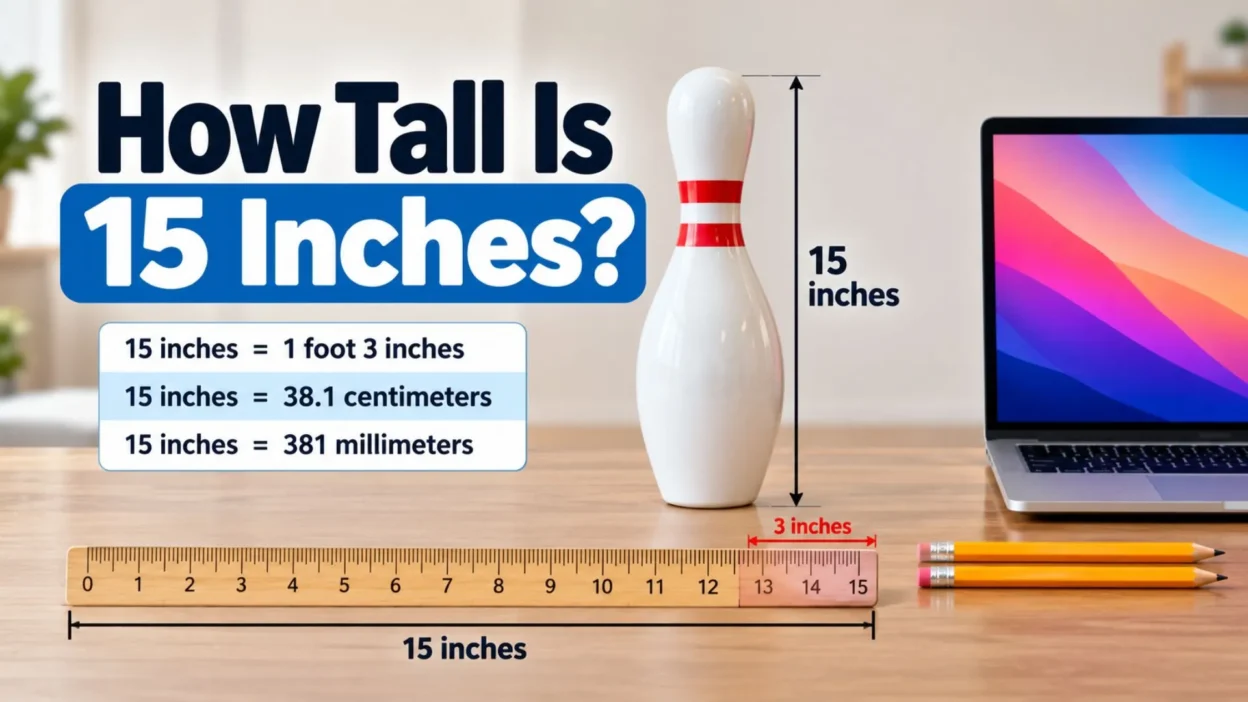
15 inches is equal to 1 foot 3 inches, 38.1 centimeters, or 381 millimeters. It is slightly longer than a standard 12-inch ruler, making it easy to visualize with everyday objects.
Whether you are measuring furniture, comparing product dimensions, choosing a laptop, or working on a DIY project, understanding how tall 15 inches is can help you picture the measurement accurately. This guide covers real-life comparisons, unit conversions, practical examples, and frequently asked questions.
How Tall Is 15 Inches in Feet and Centimeters?
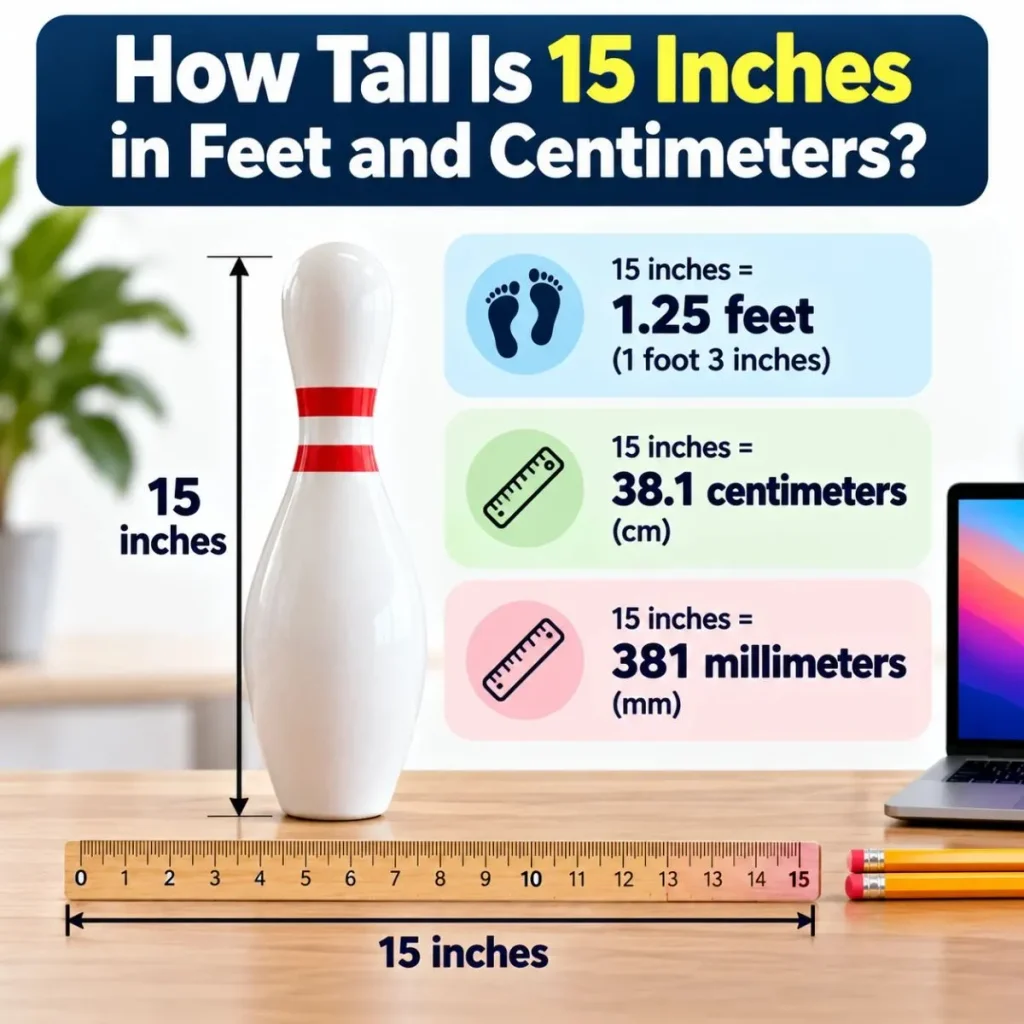
Fifteen inches equals 1.25 feet or 38.1 centimeters. In feet and inches, it is written as 1 foot 3 inches.
Here is a quick breakdown:
| Measurement unit | Equivalent |
|---|---|
| Inches | 15 inches |
| Feet | 1.25 feet |
| Feet and inches | 1 foot 3 inches |
| Centimeters | 38.1 cm |
| Millimeters | 381 mm |
| Meters | 0.381 m |
| Yards | Approximately 0.417 yards |
These values make it easy to compare 15 inches across different measurement systems. The inch-to-centimeter conversion is exact because one inch is defined as 2.54 centimeters.
What Does 15 Inches Look Like in Real Life?

Visual comparisons are a simple way to understand a measurement without using a ruler. Several familiar objects can help you picture a length or height of 15 inches.
1. A Standard Bowling Pin
A regulation ten-pin bowling pin is approximately 15 inches tall. Therefore, imagining a bowling pin standing upright provides a helpful reference for this measurement.
Its height is measured vertically from the bottom of its base to the top. Although decorative bowling pins may have different dimensions, regulation pins offer a useful comparison.
2. A 12-Inch Ruler Plus 3 Inches
A standard 12-inch ruler is one foot long. To reach 15 inches, you need another 3 inches beyond its end.
Think of the measurement as two sections:
- First section: 12 inches
- Additional section: 3 inches
- Total: 15 inches
This is one of the easiest ways to estimate 15 inches when you have a regular school ruler available.
3. A 15-Inch Laptop Screen
A laptop with a 15-inch screen offers another familiar comparison. However, the advertised screen size refers to its diagonal, measured from one corner of the display to the opposite corner.
For a screen with a 16:9 aspect ratio, a 15-inch diagonal corresponds to approximately 13.1 inches in width and 7.4 inches in height.
The laptop itself is larger than the display because its frame, keyboard, and outer casing add extra dimensions. Consequently, a 15-inch laptop does not have a screen that is 15 inches tall.
4. Two Pencils Placed End to End
Imagine two pencils that are each approximately 7.5 inches long. When you place them in a straight line, their combined length is about 15 inches.
This comparison is useful for visual estimation, particularly for students and people working on crafts. However, pencil lengths vary, so this method should not replace an accurate measurement when precision matters.
5. A Small Household Object
Many small household objects have at least one dimension close to 15 inches. For example, a decorative item, storage container, or small organizer might measure around 15 inches in height, width, or depth.
The exact comparison depends on the product. Always check the listed dimensions because an item’s width may be 15 inches even when its height is much shorter.
How Tall Is 15 Inches Compared With a Person?
Compared with an adult’s total height, 15 inches is relatively short. It equals 38.1 centimeters, which represents only a small portion of an average adult’s height.
For a rough visual comparison, a 15-inch object placed on the floor may reach somewhere around the knee area of some adults. However, this varies considerably with a person’s height, leg length, and proportions.
Here are a few additional comparisons:
- Compared with an adult: 15 inches is a small fraction of total body height.
- Compared with a forearm: It may be longer than the elbow-to-wrist distance of some people.
- Compared with a baby: Fifteen inches is shorter than the typical full body length of a newborn.
- Compared with a chair: It could be close to the height of a low stool or another small piece of furniture, depending on its design.
These comparisons are only estimates. If you need a measurement for clothing, furniture, or another practical purpose, use a measuring tape rather than relying on body proportions.
How to Convert 15 Inches Into Different Units
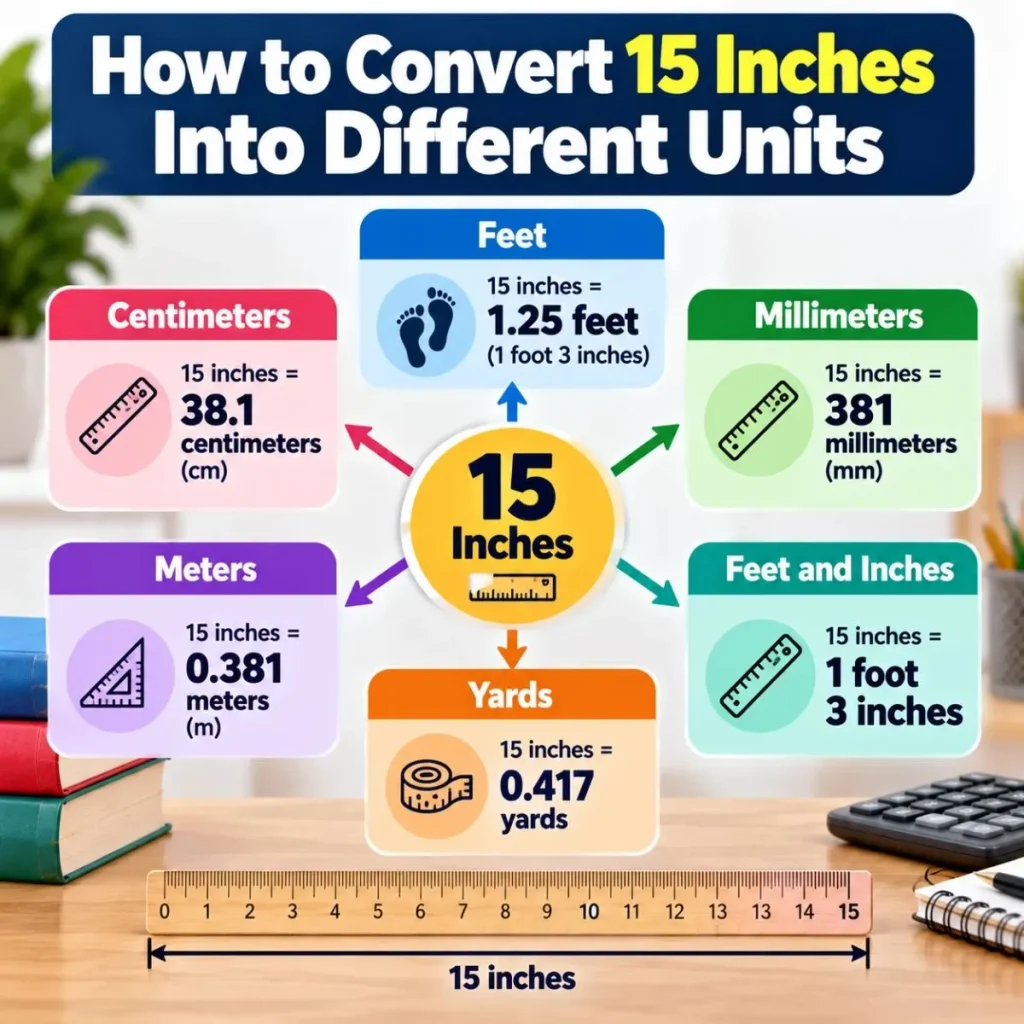
Converting inches is straightforward when you know the correct conversion factor. The following calculations show how to convert 15 inches into feet, centimeters, and millimeters.
Inches to Feet
There are 12 inches in one foot. To convert inches to feet, divide the number of inches by 12.
Formula:
15 ÷ 12 = 1.25 feet
Therefore, 15 inches equals 1.25 feet, or 1 foot 3 inches.
Inches to Centimeters
One inch equals exactly 2.54 centimeters. Multiply the number of inches by 2.54 to convert the measurement.
Formula:
15 × 2.54 = 38.1 centimeters
Therefore, 15 inches equals exactly 38.1 centimeters.
Inches to Millimeters
One inch equals 25.4 millimeters. To convert 15 inches to millimeters, multiply 15 by 25.4.
Formula:
15 × 25.4 = 381 millimeters
Therefore, 15 inches equals 381 millimeters.
Inches to Meters
One meter contains 100 centimeters. Since 15 inches equals 38.1 centimeters, divide 38.1 by 100.
Formula:
38.1 ÷ 100 = 0.381 meters
Therefore, 15 inches equals 0.381 meters.
Is 15 Inches Considered Big or Small?

Whether 15 inches is considered big depends on the object being measured.A 15-inch item can look quite large when it is small. However, it looks smaller next to bigger things, such as a table or television.
| Object or situation | How 15 inches compares |
|---|---|
| Bowling pin | Approximately the standard height |
| School ruler | 3 inches longer than a 12-inch ruler |
| Laptop screen | A common diagonal screen size |
| Small storage container | Could be a height, width, or depth |
| Low stool | Could be a possible seat height |
| Adult human height | A very small measurement |
For this reason, the measurement alone does not tell you whether an object is large. You also need to know its purpose, shape, and other dimensions.
Where Is a 15-Inch Measurement Useful?
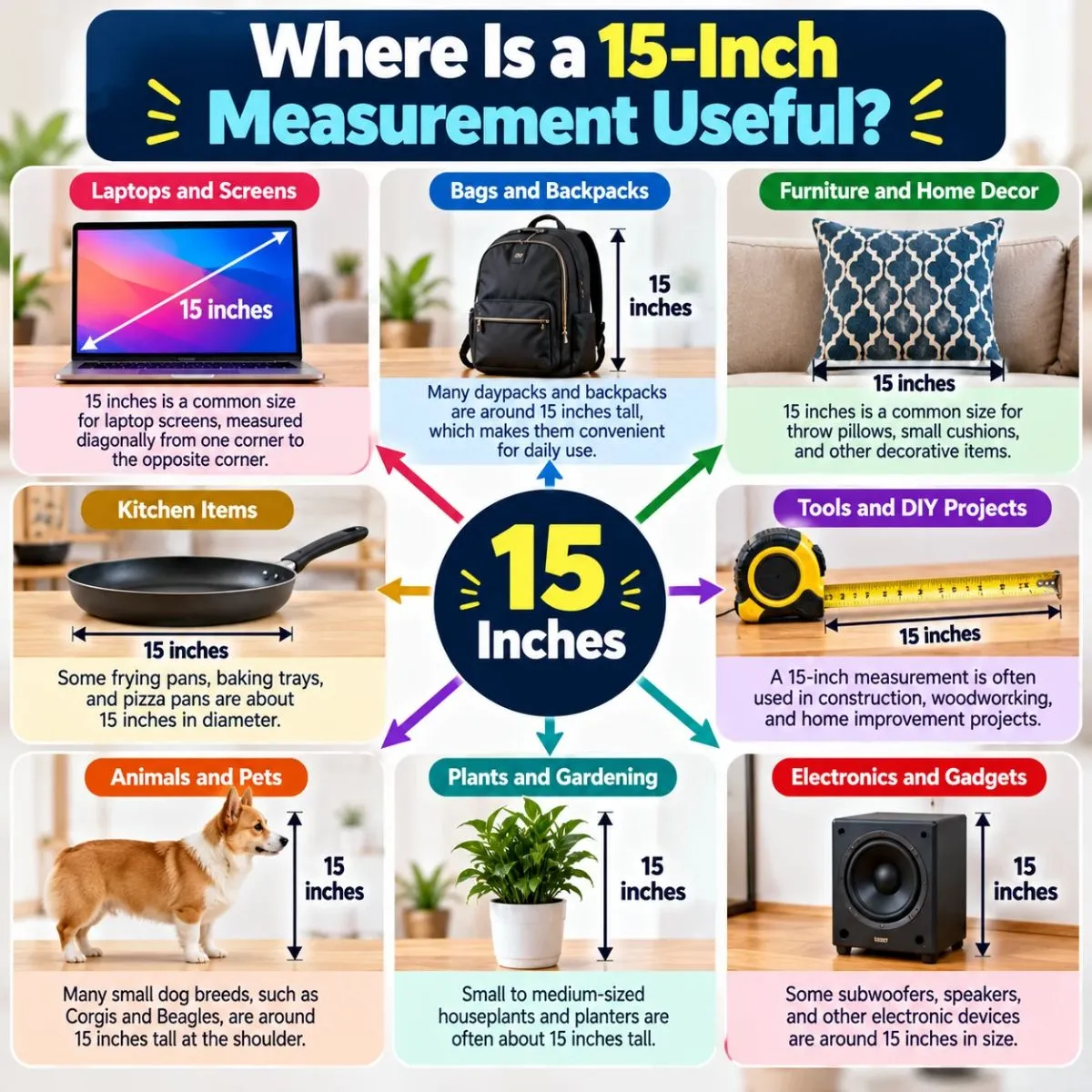
Understanding 15 inches can help with several everyday tasks. Although the measurement is relatively short, it appears in many product dimensions and practical projects.
Home Organization
Storage boxes, shelves, organizers, and decorative objects may have a dimension of 15 inches. Checking the measurement before purchasing helps you determine whether an item will fit the available space.
For example, if a shelf opening is 16 inches wide, an object that is 15 inches wide may fit, provided there is enough clearance and the measurements account for any handles or protruding parts.
Furniture Planning
Small tables, stools, and other furniture can have dimensions close to 15 inches. However, always distinguish between seat height, total height, width, and depth.
A stool that is 15 inches high is different from one that is 15 inches wide. Checking the manufacturer’s specifications prevents confusion.
Crafting and DIY Projects
Fifteen inches can be useful when cutting cardboard, measuring fabric, building small objects, or marking materials for a home project.
For accurate results, measure from the correct starting point and mark the endpoint clearly. If the project requires precise cuts, use a ruler or tape measure rather than estimating the distance visually.
Shopping for Electronics
A laptop described as having a 15-inch display uses a diagonal screen measurement. This detail matters when comparing laptops, purchasing sleeves, or estimating screen dimensions.
Because the outer casing is larger than the display itself, check the manufacturer’s full product dimensions when choosing a carrying case or planning storage space.
Common Mistakes When Measuring 15 Inches
A few common misunderstandings can lead to incorrect measurements. Keeping the following points in mind makes comparisons more reliable.
Confusing inches with feet: Fifteen inches equals 1.25 feet, not 15 feet. Remember that one foot contains 12 inches.
Assuming a 15-inch screen is 15 inches tall: Screen sizes are generally measured diagonally. The actual height and width depend on the screen’s aspect ratio.
Relying on estimates from everyday objects: Pencils, household containers, and furniture come in different sizes. Use them as rough references rather than exact standards.
Ignoring the direction of measurement: Height, width, depth, and diagonal length describe different dimensions. Always check which one is being reported.
Rounding too early: If accuracy matters, retain the correct conversion values during calculations. For example, 15 inches is exactly 38.1 centimeters, not simply 38 centimeters.
Frequently Asked Questions
How many feet is 15 inches?
Fifteen inches equals 1.25 feet, which is the same as 1 foot 3 inches.
How many centimeters is 15 inches?
Fifteen inches equals exactly 38.1 centimeters.
Is 15 inches more than one foot?
Yes. One foot contains 12 inches, so 15 inches is 3 inches longer than one foot.
What common object is approximately 15 inches tall?
A regulation ten-pin bowling pin is approximately 15 inches tall, making it a useful real-life comparison.
How many millimeters are in 15 inches?
Fifteen inches equals 381 millimeters.
Is 15 inches the same as 38 centimeters?
Not exactly. Fifteen inches equals 38.1 centimeters, which is 0.1 centimeters more than 38 centimeters.
How can I measure 15 inches without a measuring tape?
You can use a 12-inch ruler and measure an additional 3 inches. A smartphone measuring app may also provide an estimate, although its accuracy can vary.
Is a 15-inch laptop 15 inches wide?
Not necessarily. The advertised screen size generally refers to its diagonal, while the screen’s width depends on its aspect ratio. The full laptop casing is wider than the display itself.
Conclusion
Fifteen inches equals 1 foot 3 inches, 38.1 centimeters, or 381 millimeters. You can picture this measurement by imagining a 12-inch ruler with another 3 inches added or by comparing it with a regulation bowling pin.
Ultimately, the easiest way to understand 15 inches is to connect the number with a familiar object and remember which dimension is being measured. For everyday estimates, visual comparisons are useful. For shopping, construction, and DIY projects, a physical ruler or measuring tape provides a more dependable result.