Two inches might sound like a tiny measurement, but it is surprisingly useful in everyday life. It can describe the width of a small object, the height of a compact accessory, the size of a household item, or the difference between two measurements that look almost identical.
The tricky part is imagining exactly how much space 2 inches takes up without holding a ruler. Is it closer to the width of your fingers, the length of a coin, or the size of something you use every day?
Once you compare it with familiar objects, the measurement becomes much easier to picture. Whether you are checking a product’s dimensions, measuring a small gap, working on a DIY project, or simply curious about how big 2 inches is, a few everyday references can help.
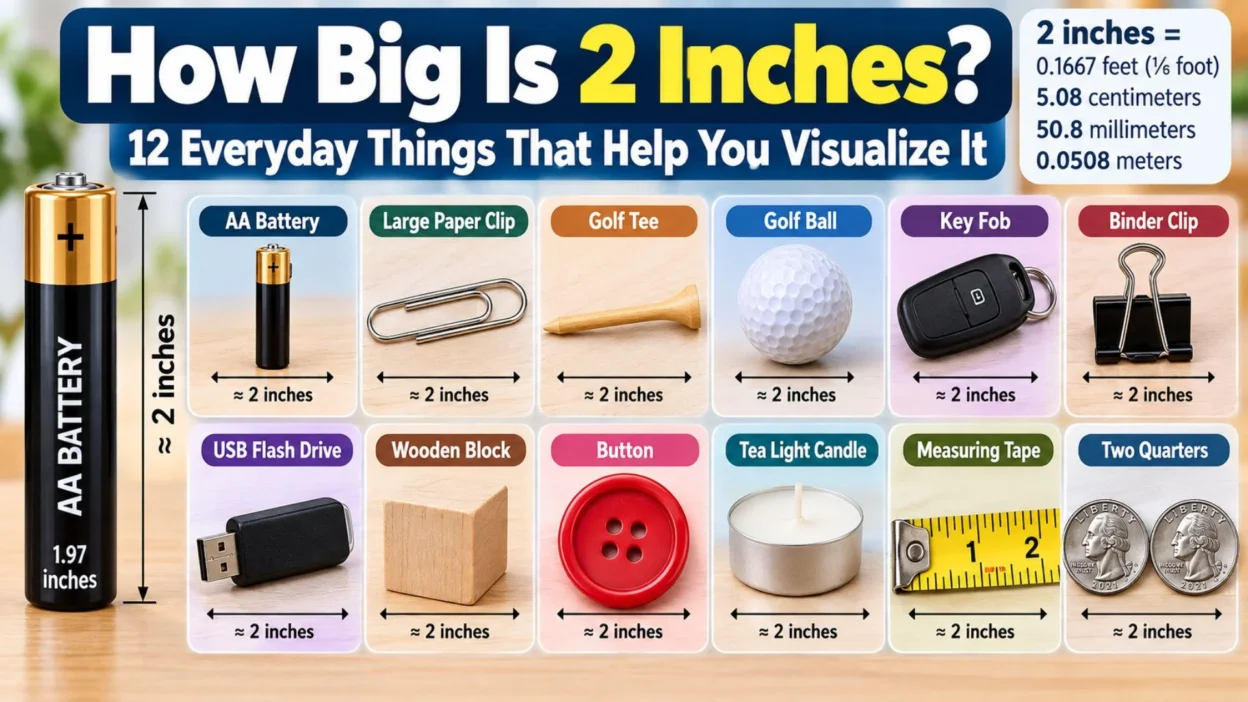
2 inches equals ⅙ of a foot, 5.08 centimeters, 50.8 millimeters, and 0.0508 meters. It is a little over 5 centimeters long, making it a compact measurement that you can visualize using common household items.
This guide covers the exact conversions, 12 practical size comparisons, ways to estimate 2 inches without a measuring tape, and answers to common questions about this length.
Table of Contents
- Every Unit 2 Inches Converts To
- Where 2 Inches Fits on a Common Size Scale
- 12 Things That Measure About 2 Inches
- What Does a 2-Inch Measurement Actually Mean?
- Getting to 2 Inches Without a Tape Measure
- Frequently Asked Questions
- Where That Leaves You
Every Unit 2 Inches Converts To
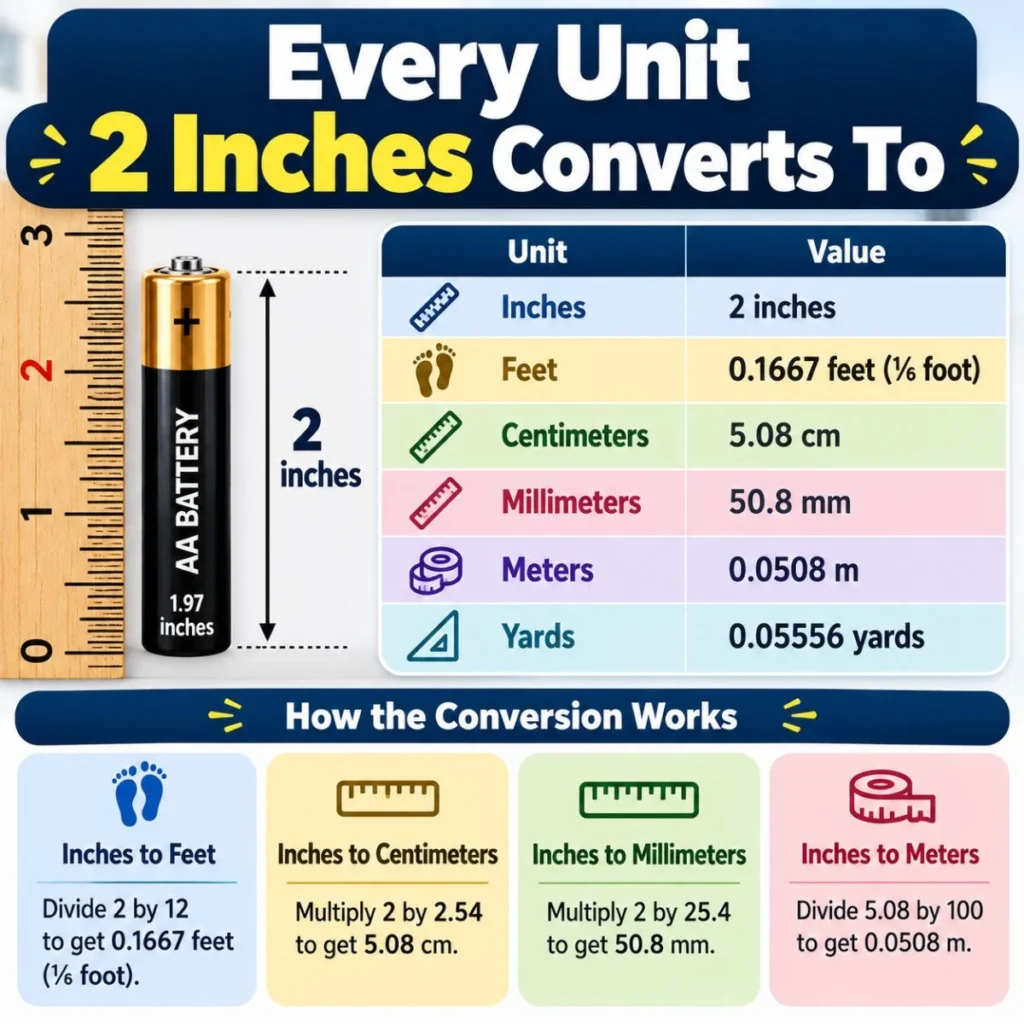
Two inches is a short length in the imperial measurement system, but converting it into other units makes it easier to understand when shopping, building, crafting, or comparing dimensions.
Here is the complete conversion table for 2 inches.
| Unit | Value |
|---|---|
| Inches | 2 inches |
| Feet | 0.1667 feet (⅙ foot) |
| Centimeters | 5.08 cm |
| Millimeters | 50.8 mm |
| Meters | 0.0508 m |
| Yards | 0.05556 yards |
How the Conversion Math Works
Each conversion uses a fixed relationship between inches and another unit.
- Inches to feet: Divide 2 by 12. The result is approximately 0.1667 feet, or exactly one-sixth of a foot.
- Inches to centimeters: Multiply 2 by 2.54. The result is 5.08 centimeters.
- Inches to millimeters: Multiply 2 by 25.4. This gives 50.8 millimeters.
- Inches to meters: Divide 5.08 by 100 to get 0.0508 meters.
- Inches to yards: Divide 2 by 36, giving approximately 0.05556 yards.
The conversion to centimeters is especially useful because many products sold internationally list their dimensions in metric units. If a package says an item is 5.08 cm long, you now know that it measures exactly 2 inches.
The same applies when you see a measurement of 50.8 mm on a tool, component, or craft supply. It is simply another way of describing the same length.
Where 2 Inches Fits on a Common Size Scale
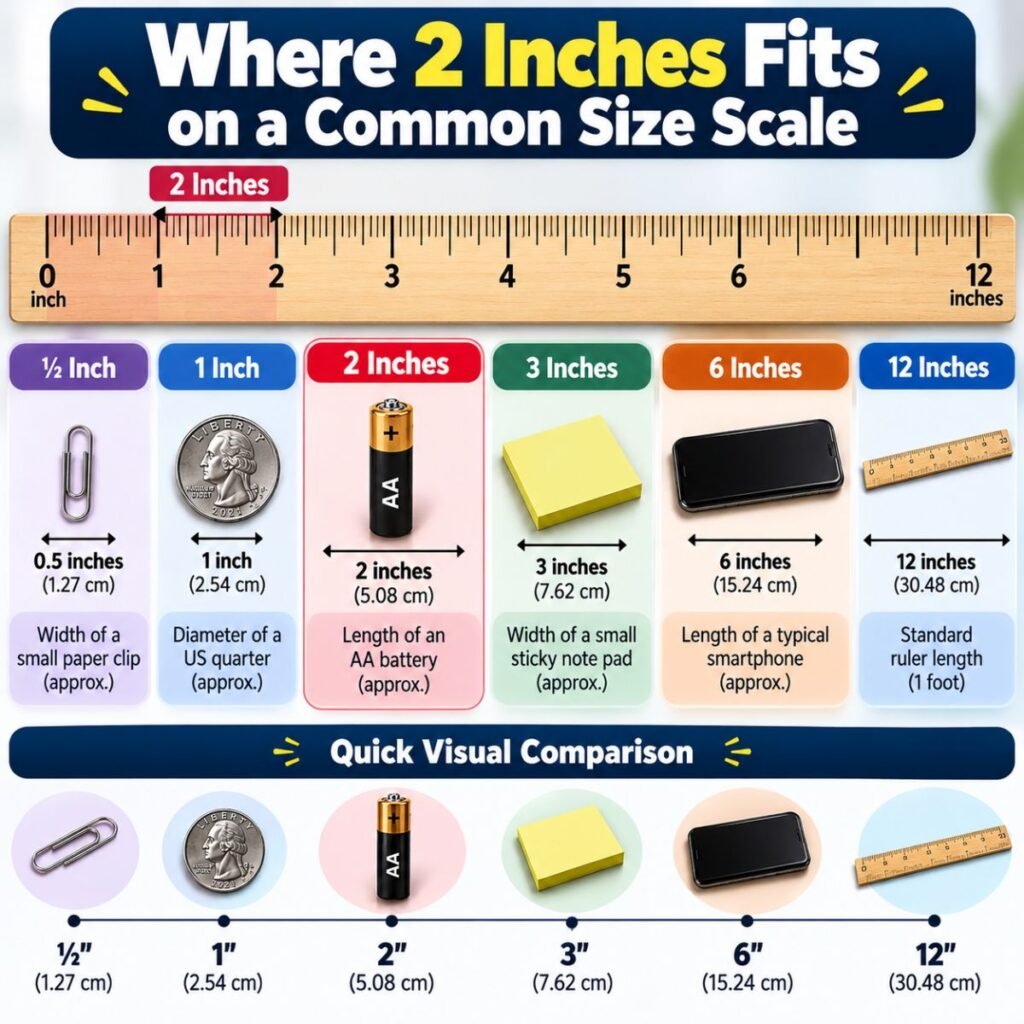
Two inches sits firmly in the small-object category. It is long enough to notice when placed beside everyday accessories, yet short enough to fit comfortably between your fingertips.
Here is how it compares with several familiar lengths:
| Measurement | Everyday scale |
|---|---|
| ½ inch | A very small gap or narrow feature |
| 1 inch | A little over 2.5 cm |
| 2 inches | 5.08 cm, about the length of a standard AA battery |
| 3 inches | 7.62 cm |
| 6 inches | Half a foot, or 15.24 cm |
| 12 inches | One foot, or 30.48 cm |
The important distinction is that length, width, and diameter describe different dimensions. A small object can be 2 inches long while being much narrower, and a round object can measure 2 inches across without being 2 inches tall.
For example, a 2-inch-wide button is not the same size as a 2-inch-long strip of material, even though both measurements are identical. The shape and direction of the measurement determine how much space an object occupies.
In practical terms, 2 inches is a useful reference for small hardware, compact accessories, craft projects, and product dimensions. It is also a convenient length to estimate by comparing objects you already own.
12 Things That Measure About 2 Inches
The easiest way to understand a small measurement is to connect it with objects you can hold, see, or find around the house.
These 12 examples include objects whose actual dimensions are close to 2 inches, along with clearly identified approximate comparisons. Sizes can vary by brand, model, and design, so the examples should be treated as visual references rather than substitutes for precise measuring.
1. A Standard AA Battery

A standard AA battery is approximately 1.97 inches (50.5 mm) long. That makes it one of the closest everyday comparisons to an exact 2-inch measurement.
AA batteries are commonly used in remote controls, wireless mice, toys, clocks, and portable electronic devices. Their standardized dimensions allow manufacturers to design battery compartments that accommodate compatible cells.
The next time you need to picture 2 inches, imagine the length of a familiar AA battery from one flat end to the other. It is just a fraction of an inch shorter than the target.
[IMAGE: a standard AA alkaline battery beside a ruler showing its approximately 2-inch length]
2. A Large Paper Clip

Some large paper clips measure close to 2 inches from end to end when laid flat. Their actual size depends on the manufacturer, but longer office paper clips provide a convenient visual reference.
Paper clips are designed to hold sheets together without staples or permanent fasteners. Their elongated shape makes it easy to compare their total length with a short measurement.
Place a large paper clip horizontally on a desk and look at the distance between its two ends. If yours is approximately 2 inches long, it provides a useful reference whenever a ruler is unavailable.
[IMAGE: a large metal paper clip placed horizontally next to a ruler marked in inches]
3. A Standard Golf Tee

Many standard wooden golf tees are around 2 to 2.5 inches long, depending on the style. A shorter tee can come quite close to the 2-inch mark.
Golf tees hold a golf ball above the ground before a player takes a shot. Their length varies because different clubs and playing conditions call for different tee heights.
A short golf tee is particularly easy to visualize because its narrow shaft and pointed end make the overall length obvious. Compare the entire tee, from its cup-shaped top to its tip, rather than measuring only the exposed portion when it is in the ground.
[IMAGE: a short wooden golf tee lying beside an inch ruler to illustrate a length near two inches]
4. A Golf Ball’s Diameter

A regulation golf ball has a minimum diameter of 1.68 inches (42.67 mm). That is about 0.32 inches less than 2 inches, making it a slightly smaller comparison.
Golf balls are manufactured to meet standardized size and weight requirements for play. Their compact, round shape also makes them easy to compare against other small objects.
Imagine the ball’s widest point, straight across its center. Although it does not reach 2 inches, it gives you a good sense of the scale: 2 inches is noticeably wider than a golf ball, but not by a huge amount.
[IMAGE: a regulation golf ball next to a ruler with its approximately 1.68-inch diameter indicated]
5. A Small Key Fob

Some compact key fobs and remote controls measure around 2 inches along their shorter side or overall length. The exact dimensions depend heavily on the design.
Key fobs are made to fit comfortably in a pocket or attach to a key ring. Their small size is practical for carrying, while the buttons and electronic components still need enough room to function.
A compact key fob can help you picture how much space 2 inches occupies in your hand. Check its actual dimensions before using it as a precise reference, since some models are considerably longer.
[IMAGE: a compact key fob placed beside a ruler showing its short dimension near two inches]
6. A Small Binder Clip

Small binder clips vary in size, but some models have an overall width or handle-to-handle dimension close to 2 inches. This makes them useful for visualizing a short horizontal span.
Binder clips are designed to grip stacks of paper using a spring-loaded metal mechanism. Their dimensions are often listed by jaw width, which is not necessarily the same as their total height or length.
When comparing one with 2 inches, identify the dimension being measured. A clip that is 2 inches wide may be much shorter in height, and its handles can extend beyond the body.
[IMAGE: a small black binder clip with its width measured next to an inch ruler]
7. A Compact USB Flash Drive

Some USB flash drives measure close to 2 inches long, including their casing. However, modern designs range from tiny, low-profile drives to longer models with protective caps.
The compact dimensions make flash drives easy to carry on a key ring, in a pocket, or inside a laptop bag. Their small size also helps them fit into crowded workspaces.
If you have a traditional USB drive, place it next to a ruler and compare its full length with 2 inches. It is a useful reference for understanding the dimensions of small electronic accessories, although not every drive will match.
[IMAGE: a compact USB flash drive placed horizontally beside a ruler showing its overall length]
8. A Small Wooden Craft Block

Small wooden craft blocks are often sold in a range of standard dimensions, including 2-inch cubes. A cube measuring 2 inches on each side is exactly 5.08 cm tall, wide, and deep.
These blocks are used in school projects, craft activities, model-making, and decorative displays. Their simple geometry makes them especially helpful when learning about dimensions.
A 2-inch cube is a particularly clear example because all three of its dimensions are the same. Looking at one gives you a sense of both a 2-inch length and the amount of space a small three-dimensional object can occupy.
[IMAGE: a two-inch wooden craft cube beside an inch ruler showing its side length]
9. A Small Round Button

Some oversized coat, costume, and decorative buttons measure around 2 inches across. Ordinary shirt buttons are much smaller, so a large decorative button is the more relevant comparison.
Larger buttons are used on coats, theatrical costumes, crafts, and decorative garments. Their diameter provides a simple way to understand a 2-inch circular measurement.
To visualize the size, imagine a large button with a diameter of 2 inches. A straight line passing through its center from one edge to the other would measure 5.08 cm, even though the curved edge around the button is longer.
[IMAGE: a large round decorative button beside a ruler showing its approximately two-inch diameter]
10. A Small Tea Light Candle

A typical tea light candle is approximately 1.5 inches across, although some larger varieties approach 2 inches in diameter. It is a useful near-match for visualizing the width of a small circular object.
Tea lights are commonly placed in decorative holders, used for ambient lighting, or included in seasonal decorations. Their compact size allows several to fit on a tray or table.
Look at the widest part of the candle’s metal cup. A larger tea light measuring close to 2 inches across can help you imagine the target width, but check the product dimensions if accuracy matters.
[IMAGE: a tea light candle in its metal cup beside a ruler measuring its diameter]
11. A Small Sewing Tape Measure’s Marked Section

A flexible sewing tape measure gives you a direct reference for 2 inches. The distance between the zero mark and the 2-inch mark is exactly the target measurement when the tape is properly laid flat.
Sewing tapes are commonly used for clothing alterations, body measurements, fabric work, and craft projects. Unlike a rigid ruler, a flexible tape can follow curved surfaces, although the measurement should be read along the tape itself.
This is particularly useful if you are comparing a curved or rounded object. Align the starting point at zero, then follow the scale to the 2-inch mark to see precisely how much length is involved.
[IMAGE: close-up of a flexible sewing tape measure with the zero, one-inch, and two-inch marks visible]
12. Two US Quarters Placed Side by Side

A US quarter has a diameter of approximately 0.955 inches. Placing two quarters side by side, with their edges touching, produces a combined width of about 1.91 inches.
That is just under 2 inches, making the arrangement a convenient everyday comparison. The coins are standardized in size, so the reference is more consistent than many household objects.
Place the two quarters in a straight line without overlapping them. The distance from the outer edge of the first coin to the outer edge of the second will be approximately 1.91 inches, or 4.85 cm.
[IMAGE: two US quarter-dollar coins touching edge to edge beside a ruler showing their combined width]
What Does a 2-Inch Measurement Actually Mean?
When someone says an object is 2 inches, they are usually describing one specific dimension: its length, width, height, thickness, or diameter.
Understanding which dimension is being measured matters just as much as knowing the number.
2 Inches Long
An object that is 2 inches long measures 5.08 cm from one end to the other. A short battery or a small craft piece can provide a useful reference.
2 Inches Wide
A width of 2 inches means the object spans 5.08 cm from one side to the other. This measurement is often used for small accessories, hardware, and decorative items.
2 Inches Tall
A height of 2 inches means the object rises 5.08 cm from its base to its top. A small cube measuring 2 inches on each side is a helpful way to visualize this height.
2 Inches in Diameter
For a circular object, a 2-inch diameter means the distance straight across its center is 5.08 cm. The circumference around the outside would be approximately 6.28 inches, assuming a perfect circle.
These distinctions become especially important when ordering products online. A listing that says 2 inches wide may not mean the item is 2 inches tall or long.
Getting to 2 Inches Without a Tape Measure
You do not always need a ruler to estimate 2 inches. Several common objects and simple techniques can help you get close.

1. Use an AA battery
A standard AA battery is approximately 1.97 inches long. If you have one nearby, its length is almost identical to 2 inches and makes an excellent quick reference.

2. Place two quarters together
Two US quarters placed edge to edge measure approximately 1.91 inches across. This is close enough for a rough estimate, although it falls slightly short of the exact measurement.

3. Compare it with a bank card
A standard bank card is about 3.37 inches wide. Two inches is a little under three-fifths of that width, giving you a useful reference for estimating a short distance.

4. Check a ruler or measuring tape
If you have access to an inch-marked ruler, locate the zero mark and count to the second inch line. This gives you the exact length rather than an estimate.
Remember that household comparisons are useful for visualization, not precision work. If you are cutting material, installing hardware, or checking whether a product will fit, use a proper measuring tool.
For more comparisons, see [INTERNAL LINK: How Big Is 1 Inch?] or [INTERNAL LINK: How Big Is 3 Inches?].
Frequently Asked Questions
How many feet is 2 inches?
Two inches equals exactly ⅙ of a foot, or approximately 0.1667 feet. To convert inches into feet, divide the number of inches by 12.
How many centimeters is 2 inches?
Two inches equals exactly 5.08 centimeters. This conversion uses the standard relationship of 1 inch to 2.54 centimeters.
How many millimeters is 2 inches?
Two inches equals 50.8 millimeters. This is useful when measuring small hardware, electronic components, and craft materials.
How many meters is 2 inches?
Two inches equals 0.0508 meters. It is a little over five-hundredths of a meter.
Is 2 inches considered big?
Two inches is generally a small measurement for most household objects and accessories. However, whether it is large or small depends on what you are measuring. For a tiny component, 2 inches may be substantial, while it is relatively short for furniture or building materials.
What everyday object is about 2 inches long?
A standard AA battery is approximately 1.97 inches long, making it one of the closest common comparisons. Two US quarters placed side by side measure about 1.91 inches across.
Can I measure 2 inches with my fingers?
You can estimate 2 inches using the width of your fingers or the distance between two fingertips, but hand sizes vary considerably. For an accurate measurement, use a ruler, tape measure, or another object with known dimensions.
Is 2 inches the same as 5 centimeters?
Not exactly. Two inches equals 5.08 centimeters, which is 0.08 cm longer than 5 centimeters. The difference is small, but it can matter in precise measurements.
Where That Leaves You
Two inches is a compact but useful measurement. It equals 5.08 cm, 50.8 mm, and one-sixth of a foot. Once you know those conversions, it becomes much easier to understand dimensions listed in either imperial or metric units.
For a quick real-world comparison, think of a standard AA battery. At approximately 1.97 inches long, it is almost exactly the length you are trying to picture. Two quarters placed side by side offer another convenient reference.
The next time you encounter a 2-inch measurement, visualize a small battery or check the distance on a ruler. That simple comparison can turn an abstract number into a length you can recognize and use confidently.