Choosing the right washer and dryer is not just about capacity, features, or price. You also need to know whether the appliances will fit comfortably in your laundry room, closet, or utility space. A washer that looks compact in a showroom may require extra room for hoses, doors, and ventilation once you bring it home.
Most standard washers and dryers are around 27 inches wide, but their height and depth can vary depending on the model, capacity, and design. Compact machines, stackable units, and all-in-one washer-dryer combos have different measurements that are worth understanding before making a purchase.
In this guide, you will learn about standard washer and dryer dimensions, front-load and top-load sizes, stackable configurations, and the space required for proper installation. You will also find practical measuring tips to help you choose appliances that fit your home without unnecessary surprises.
1. Standard Washer and Dryer Dimensions

Most full-size residential washers and dryers have similar exterior dimensions. However, exact measurements depend on the manufacturer and model.
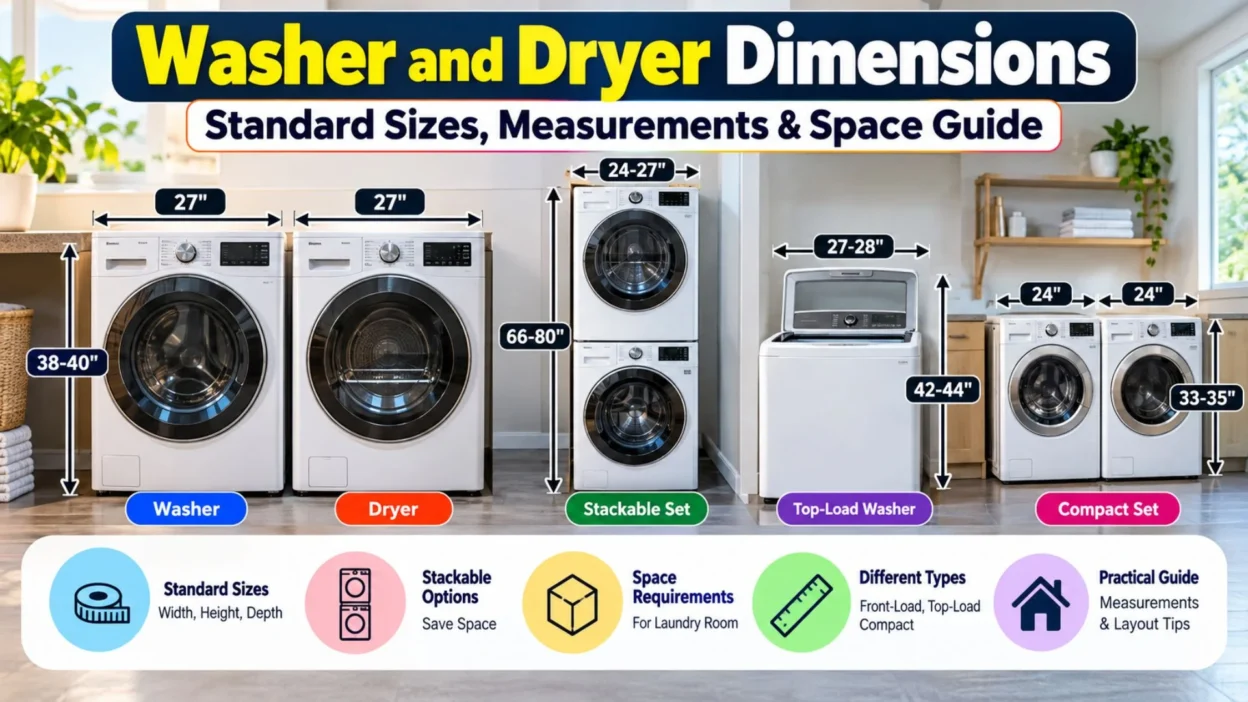
Here is a general overview of common full-size appliance dimensions.
| Appliance | Width | Height | Depth |
|---|---|---|---|
| Standard washer | 27 inches | 38–40 inches | 30–34 inches |
| Standard dryer | 27 inches | 38–40 inches | 30–34 inches |
| Compact washer | 24 inches | 33–35 inches | 24–26 inches |
| Compact dryer | 24 inches | 33–35 inches | 24–27 inches |
| Stackable laundry pair | 24–27 inches | 66–80 inches combined | 27–34 inches |
These are approximate ranges for planning purposes, not guaranteed dimensions for every appliance.
A large-capacity front-load washer or dryer may be deeper than a traditional model. Therefore, always check the manufacturer’s specification sheet before purchasing.
How much space does a standard washer and dryer need?
For a side-by-side setup, two standard 27-inch-wide appliances require approximately 54 inches of combined appliance width.
However, you should allow additional room for installation and movement.
A practical laundry space may need:
- Width: Around 60 inches or more.
- Height: At least 40–42 inches for appliances, with additional clearance if cabinets are installed above.
- Depth: Around 36–40 inches, depending on appliance depth, hoses, venting, and door clearance.
These measurements are starting points. Your actual requirements will depend on the machines and the layout of the room.
2. Front-Load Washer Dimensions

Front-load washers are popular because they offer convenient loading, efficient washing options, and the ability to stack compatible dryers above them.
Most full-size front-load washers have a width of approximately 27 inches.
| Measurement | Typical dimension |
|---|---|
| Width | 27 inches |
| Height | 38–40 inches |
| Depth | 30–34 inches |
| Capacity | Approximately 4.5–5.5 cubic feet |
Some extra-large models exceed these dimensions, particularly in depth.
Front-load washer clearance
The main consideration with a front-load washer is the space needed to open the door.
Depending on the model, the door may extend several inches beyond the front of the appliance when closed and require considerably more room when fully open.
For comfortable use, consider:
- Leaving enough open floor space in front of the washer.
- Checking whether the door swings left or right.
- Keeping nearby cabinets and walls clear of the door.
- Allowing space to bend down and load or remove laundry.
If the washer is installed inside a closet, make sure the door can open fully without hitting the closet doors or nearby walls.
3. Top-Load Washer Dimensions

Top-load washers have a lid on the upper surface rather than a front-facing door. They are often suitable for laundry rooms where front access is limited.
Typical top-load washer dimensions are:
| Measurement | Typical dimension |
|---|---|
| Width | 27–28 inches |
| Height | 42–44 inches |
| Depth | 27–29 inches |
| Capacity | Approximately 3.5–5.5 cubic feet |
The exact size varies by model, particularly for high-capacity machines.
How much clearance does a top-load washer need?
A top-load washer needs sufficient vertical clearance to open its lid.
For example, a machine that stands 43 inches tall may need substantially more than 43 inches of available height when the lid is open.
Before installing one beneath a shelf or countertop, check the fully opened lid height in the product specifications.
Top-load washers are not generally suitable for stacking with a dryer above them because the lid needs to open upward.
4. Standard Dryer Dimensions

A standard residential dryer is often similar in size to a full-size washer, making side-by-side installation straightforward.
Most conventional dryers measure approximately 27 inches wide and 38–40 inches high.
| Measurement | Typical dimension |
|---|---|
| Width | 27 inches |
| Height | 38–40 inches |
| Depth | 30–34 inches |
| Capacity | Approximately 7.0–9.0 cubic feet |
Dryer capacity is typically larger than washer capacity because clothes need room to tumble during the drying cycle.
Electric vs. gas dryer dimensions
Electric and gas dryers often have similar exterior dimensions when they belong to the same product series.
The primary difference is the type of connection required.
- Electric dryers require an appropriate electrical connection, which may be a dedicated 240-volt circuit for many full-size models.
- Gas dryers require a suitable gas connection and an electrical outlet.
Both types may require ventilation, depending on whether the model is vented or ventless.
Always follow the installation instructions for the specific dryer you purchase.
5. Stackable Washer and Dryer Dimensions

Stackable washer and dryer sets are designed to save floor space by placing the dryer above the washer.
They are particularly useful in apartments, small homes, and laundry closets.
Typical dimensions for a stacked laundry pair are:
| Measurement | Typical dimension |
|---|---|
| Width | 24–27 inches |
| Combined height | 66–80 inches |
| Depth | 27–34 inches |
A compact 24-inch stackable pair may fit into a narrower laundry area, while a full-size 27-inch pair requires more width.
How much space is needed for a stacked washer and dryer?
For a typical full-size stacked pair, plan for approximately:
- Width: 30 inches or more.
- Height: Around 84 inches or more, depending on the model and ceiling clearance.
- Depth: Approximately 36–40 inches, subject to the appliance and installation requirements.
The stacking kit must be compatible with the washer and dryer models.
Do not place a standard dryer on top of a washer unless the manufacturer specifically approves the combination and provides the appropriate stacking hardware.
6. Compact Washer and Dryer Dimensions

Compact washers and dryers are designed for smaller spaces. They are commonly used in apartments, condos, and homes with limited laundry areas.
Many compact laundry appliances are approximately 24 inches wide.
| Measurement | Compact washer | Compact dryer |
|---|---|---|
| Width | 24 inches | 24 inches |
| Height | 33–35 inches | 33–35 inches |
| Depth | 24–26 inches | 24–27 inches |
| Capacity | 2.0–2.5 cu. ft. | 4.0–4.5 cu. ft. |
Compact models may have a smaller load capacity than full-size appliances, so consider how much laundry your household typically produces.
Some compact dryers are ventless, which can make installation easier in locations where installing an exterior exhaust duct is difficult.
However, ventless models still require the clearances and airflow specified by the manufacturer.
7. Washer and Dryer Dimensions in Inches and Feet
If you are planning a laundry room or measuring a space, converting inches into feet can make the layout easier to visualize.
| Measurement | Inches | Feet |
|---|---|---|
| Appliance width | 27 inches | 2.25 feet |
| Appliance height | 40 inches | 3.33 feet |
| Appliance depth | 32 inches | 2.67 feet |
| Two machines side by side | 54 inches | 4.5 feet |
| Compact appliance width | 24 inches | 2 feet |
| Typical stacked height | 72 inches | 6 feet |
For example, two 27-inch-wide machines placed side by side occupy 4.5 feet of width before adding any installation clearance.
This can help when planning a laundry area in a house, apartment, or utility room.
8. Washer and Dryer Closet Dimensions

A laundry closet can accommodate a side-by-side pair or a stacked set, depending on its width and depth.
The following dimensions are practical starting points for planning a residential laundry closet.
| Layout | Approximate planning dimensions (W × D × H) |
|---|---|
| Side-by-side full-size | 60 × 36–40 × 84 inches |
| Side-by-side compact | 52 × 30–34 × 80 inches |
| Full-size stacked | 30 × 36–40 × 84 inches |
| Compact stacked | 27 × 30–34 × 80 inches |
These are not universal minimum code dimensions. Local building requirements and manufacturer instructions may require additional space.
Important laundry closet considerations
First, measure the closet opening as well as the interior. A machine may fit inside the closet but still be too wide or tall to pass through the doorway.
Second, check the door arrangement. Bifold or sliding doors may help preserve floor space, but the closet still needs suitable ventilation and access.
Finally, account for water supply connections, drain hoses, electrical outlets, and dryer exhaust ducts where applicable.
9. How to Measure for a Washer and Dryer
Before ordering appliances, take a few simple measurements.

Step 1: Measure the available width
Measure from one side of the installation area to the other.
For side-by-side appliances, add the widths of both machines and any required gap between them.
For example, two 27-inch machines need 54 inches of appliance width before installation clearances.
Step 2: Measure the available depth
Measure from the back wall to the front edge of the available space.
Include room for water hoses, drain connections, power cords, and dryer venting.
Remember that the appliance’s listed depth may not include every connection or the distance needed for its door.
Step 3: Measure the height
Measure from the floor to the lowest obstruction above the appliances.
For a stacked unit, include the height of both appliances and the stacking kit.
For a top-load washer, check the height with the lid open.
Step 4: Measure doorways and access routes
Measure the width and height of entry doors, hallways, stairs, and turns along the delivery route.
Also check whether the appliance can be maneuvered into the laundry room without removing doors or damaging walls.
Step 5: Check the manufacturer’s installation guide
The product specification sheet should identify the appliance’s exact dimensions and recommended installation clearances.
Use those measurements to finalize your layout before purchasing.
10. Frequently Asked Questions
How wide is a standard washer and dryer?
Most standard residential washers and dryers are approximately 27 inches wide. Some models are wider or narrower, so check the specifications of the exact appliance.
How deep is a standard washer and dryer?
Many full-size models are around 30–34 inches deep. Extra-large machines may be deeper, and the total installed depth can increase when hoses, venting, and doors are included.
How much space do I need for a washer and dryer side by side?
Two standard 27-inch machines require 54 inches of combined width. A space around 60 inches wide is a practical starting point, with additional depth and clearance based on the installation instructions.
Can a washer and dryer fit in a 5-foot-wide closet?
A 5-foot-wide closet is 60 inches across, which may accommodate two standard 27-inch machines side by side. However, you must also consider the closet opening, installation clearances, hoses, and door operation.
Are all stackable washers and dryers the same size?
No. Compact and full-size stackable pairs have different dimensions. Even appliances with the same width may differ in height and depth. Always confirm compatibility and use the correct stacking kit.
How tall is a stacked washer and dryer?
A stacked washer and dryer pair is commonly around 66–80 inches tall, depending on the appliances and stacking hardware.
Do washer and dryer dimensions include hoses?
Not always. Published dimensions generally describe the appliance itself. Hoses, vent connections, cords, and other installation components may require extra space.
Conclusion
Washer and dryer dimensions are essential when designing a laundry room, choosing appliances, or upgrading an existing laundry space. Most full-size machines are approximately 27 inches wide, while compact models are often around 24 inches wide.
For side-by-side installation, start by measuring the combined appliance width, depth, and available height. If you prefer a stacked arrangement, check the total height and confirm that the machines are designed to work together.
Most importantly, use the manufacturer’s exact dimensions and installation requirements before making your final purchase. A few careful measurements can help you avoid delivery problems and create a laundry space that is practical and comfortable to use.