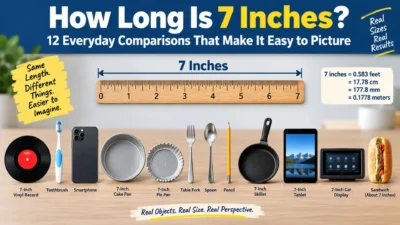
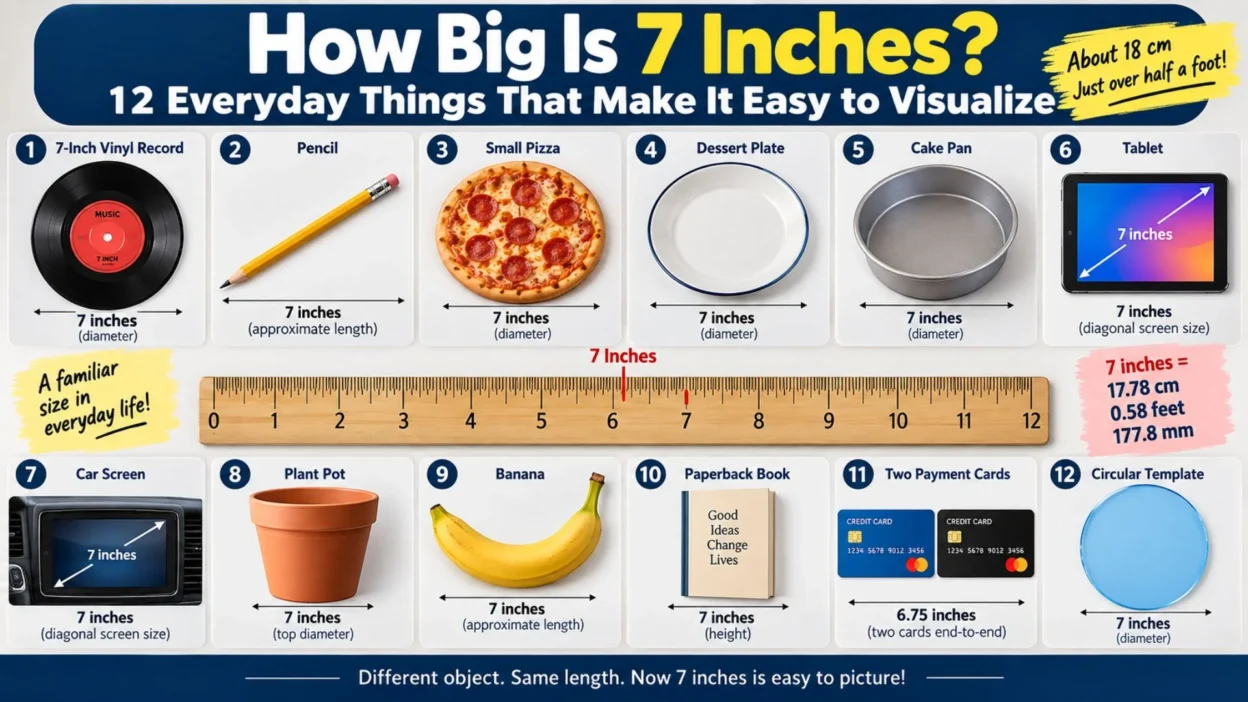
Seven inches does not sound particularly large, but it can be surprisingly difficult to picture until you compare it with something familiar. Put a ruler in front of you and the answer is obvious. Without one, however, a number such as 7 inches can feel strangely abstract.
That is why everyday objects are useful. A pencil, small plate, vinyl record, payment card, or compact screen can give you a much better mental picture of the distance.
If you are searching how big is , the exact conversion is straightforward. Seven inches equals 17.78 centimeters, which is just under 18 centimeters. It is also a little more than half a foot.
7 inches equals 0.5833 feet, 17.78 centimeters, 177.8 millimeters, and 0.1778 meters.
In this guide, you will see the complete conversions, where sits on a normal measurement scale, and more than a dozen practical comparisons that make the size easier to visualize.
Table of Contents
- Every Unit 7 Inches Converts To
- Where 7 Inches Sits on a Common Size Scale
- 12 Things That Measure About 7 Inches
- The 7-Inch Screen Question People Actually Mean
- Getting to 7 Inches Without a Tape Measure
- FAQs About 7 Inches
- Where That Leaves You
Every Unit 7 Inches Converts To
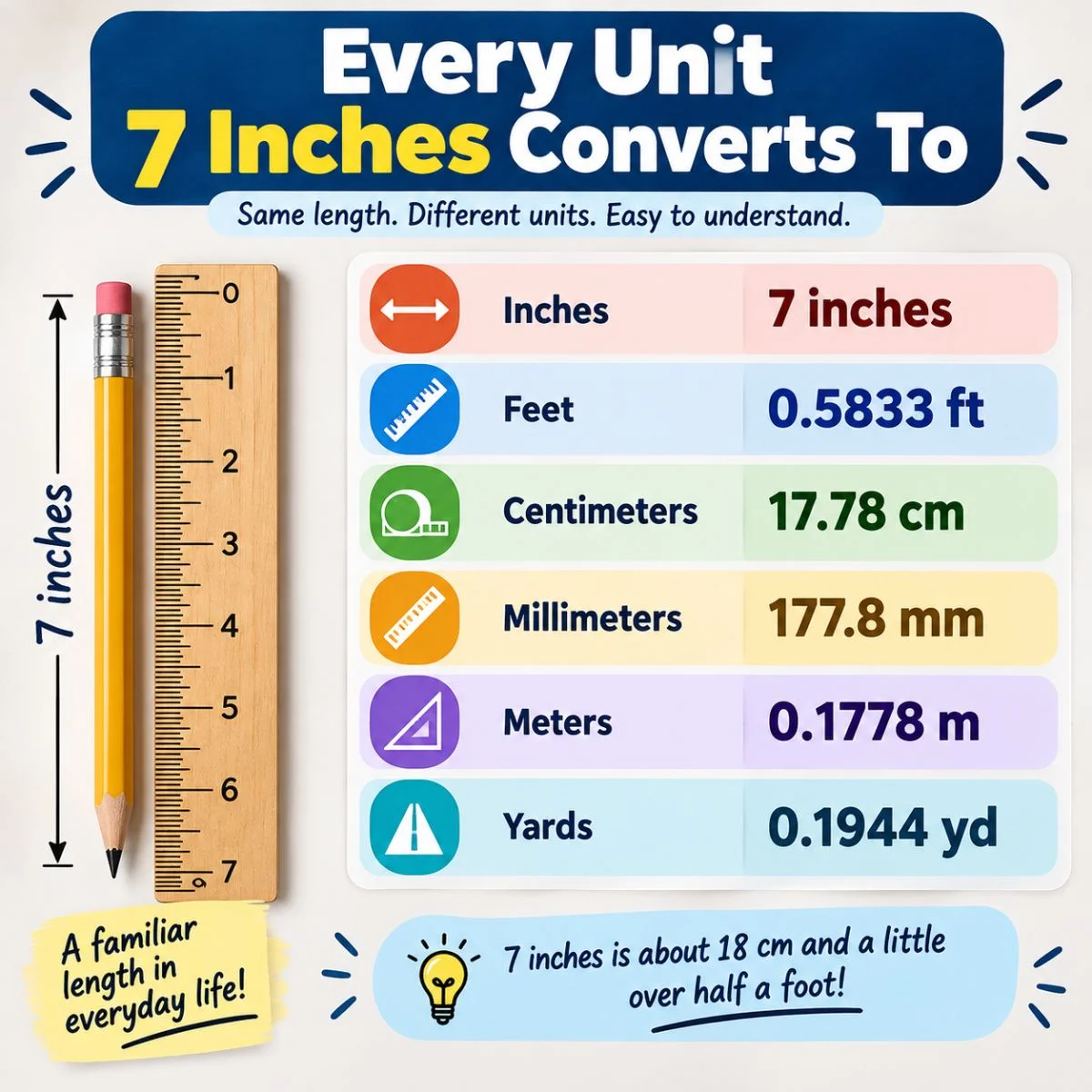
The easiest starting point is to convert 7 inches into the units you are most likely to encounter.
| Unit | Value |
|---|---|
| Inches | 7 inches |
| Feet | 0.5833 ft |
| Centimeters | 17.78 cm |
| Millimeters | 177.8 mm |
| Meters | 0.1778 m |
| Yards | 0.1944 yd |
7 inches in feet
There are 12 inches in one foot, so divide 7 by 12:
7 ÷ 12 = 0.5833 feet
Therefore, 7 inches is about 0.58 feet.
It is worth remembering that is not 0.7 feet. The inch-to-foot conversion is based on 12 inches per foot, not 10.
7 inches in centimeters
One inch equals exactly 2.54 centimeters.
So:
7 × 2.54 = 17.78 cm
Therefore, 7 inches is exactly 17.78 centimeters.
For everyday estimation, you can round this to approximately 18 cm.
7 inches in millimeters
There are 10 millimeters in a centimeter.
17.78 × 10 = 177.8 mm
So 7 inches equals 177.8 millimeters.
7 inches in meters
Since 100 centimeters make one meter:
17.78 ÷ 100 = 0.1778 meters
That means 7 inches is 0.1778 meters, or approximately 0.18 meters.
7 inches in yards
One yard contains 36 inches.
7 ÷ 36 = 0.1944 yards
So 7 inches is approximately 0.194 yards.
For most everyday situations, centimeters and feet are more useful than yards for such a short measurement.
Quick conversion to remember
If you do not want to remember every decimal, keep this simple version in mind:
7 inches ≈ 18 cm ≈ 0.58 feet
That is usually enough for a quick visual estimate.
Where 7 Inches Sits on a Common Size Scale
Seven inches sits a little beyond the halfway point of a one-foot ruler.
A full foot contains 12 inches, so there are still 5 inches left after reaching the -inch mark. In other words, is approximately 58% of a foot.
Another helpful reference is standard US Letter paper. The short side of Letter paper measures 8.5 inches. A length is therefore 1.5 inches shorter than that side.
A4 paper provides a similar comparison. Its short side is approximately 8.27 inches, so 7 inches is also clearly shorter than the width of A4 paper.
The measurement becomes even easier to understand when compared with a standard payment card. A typical bank or credit card is about 3.375 inches long. Two cards placed end-to-end measure about 6.75 inches, which is only a quarter-inch less than 7 inches.
This makes a useful middle-sized measurement. It is too long to describe as tiny, but it is still short enough to fit comfortably within one hand for many people.
One important detail is that 7 inches does not always describe the longest side of an object. A circular object may use 7 inches as its diameter, while an electronic display may use 7 inches as its diagonal.
Always check which dimension the manufacturer or measurement refers to.
12 Things That Measure About 7 Inches
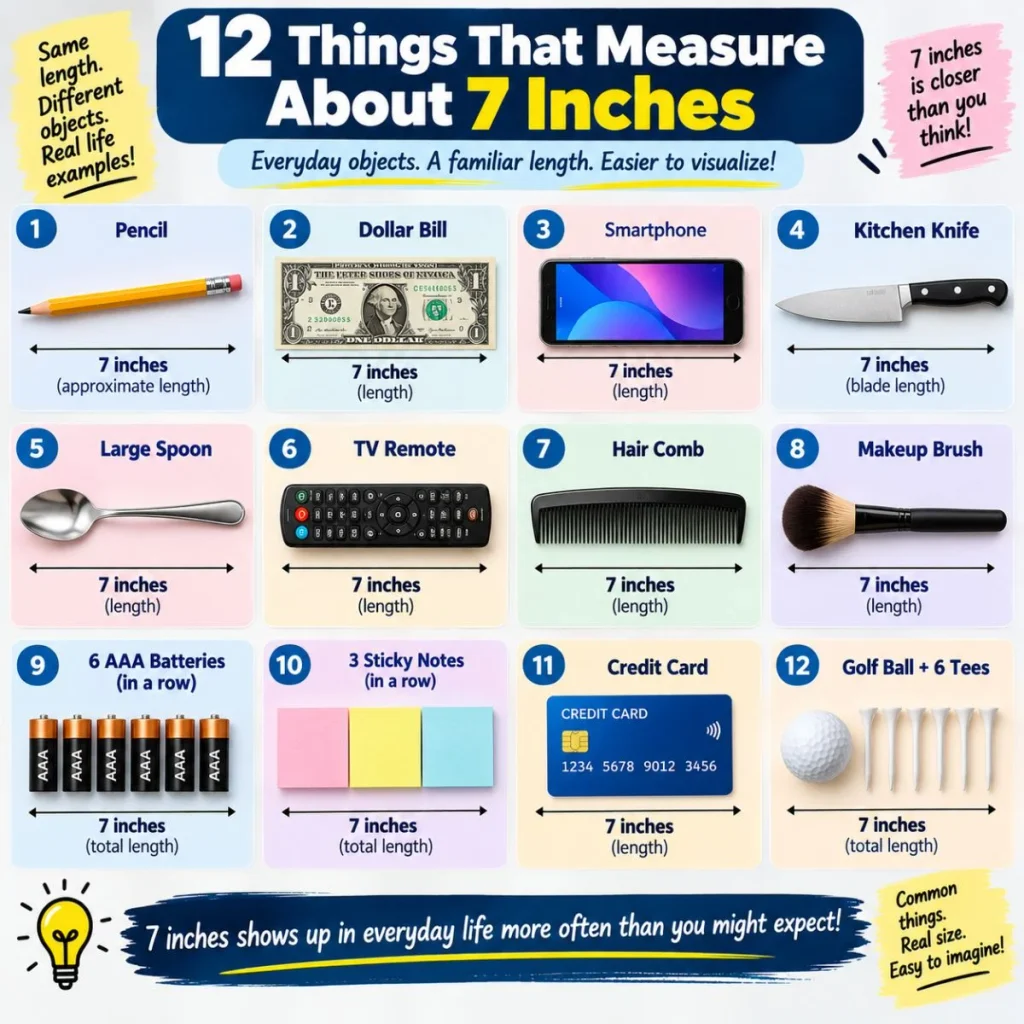
The most useful way to understand how big is is to compare it with objects you can actually see and hold.
Some examples below are standardized around, while others are approximate everyday comparisons. The distinction matters because natural and manufactured objects do not all have fixed dimensions.
A 7-Inch Vinyl Record
A 7-inch vinyl record is one of the strongest examples because the format is named for its approximate diameter.
Its diameter is about 7 inches, which equals 17.78 cm. If you measure straight across the center from one edge to the other, you are looking at roughly
These records are much smaller than the familiar 12-inch LP format. Their compact circular shape makes the measurement easy to visualize.
Imagine placing a ruler across the center of the record. The 7-inch mark would reach the opposite side.
[IMAGE: a 7-inch vinyl record beside a ruler showing its diameter]
A Full-Size Pencil
A new standard wooden pencil is often around 7 to 8 inches long, depending on the design and manufacturer.
That puts 7 inches close to the length of many ordinary pencils before they have been used extensively.
The comparison becomes less accurate as the pencil is sharpened because sharpening gradually reduces its overall length.
Still, if someone asks for a quick visual comparison, picturing a new full-size pencil gives you a useful approximation of the measurement.
[IMAGE: a new standard wooden pencil beside a ruler with the 7-inch point highlighted]
A 7-Inch Pizza
A pizza advertised as 7 inches generally has an approximate 7-inch diameter.
That means the straight distance across the pizza through its center is about 17.78 cm. Its radius would be approximately 3.5 inches.
A pizza this size is relatively small compared with many restaurant pizzas. The actual serving size depends on the crust, toppings, and thickness.
The circular shape makes it especially useful for visualizing 7 inches because you can see the entire diameter at once.
[IMAGE: a 7-inch personal pizza beside a ruler for scale]
A Small Dessert Plate
Some dessert plates and side plates are made in the 6- to 7-inch range.
A plate close to across is noticeably smaller than a typical dinner plate, which often has a diameter around 10 to 11 inches.
The easiest way to check one is to measure across the center from one outside edge to the other.
Because plate sizes vary by manufacturer, use this as an approximation unless the plate’s specifications state an exact diameter.
[IMAGE: small dessert plate approximately 7 inches in diameter beside a ruler]
A 7-Inch Cake Pan
Seven-inch round cake pans are available for smaller baking projects.
In this case, the 7-inch measurement normally refers to the approximate diameter of the round pan rather than its height.
Compared with an 8- or 9-inch cake pan, a 7-inch pan has a noticeably smaller circular surface area. That can change how thick a cake becomes when using the same amount of batter.
For visualization, imagine a circular object measuring 7 inches straight across its middle.
[IMAGE: 7-inch round cake pan with a ruler measuring across its diameter]
A 7-Inch Tablet Display
A 7-inch tablet provides an important example because its 7-inch measurement does not describe its width.
Tablet displays are normally measured diagonally. The measurement runs from one corner of the active display to the opposite corner.
The actual width and height depend on the display’s aspect ratio. The tablet’s outer body can also be larger because of the bezel and casing.
So a 7-inch tablet should not be imagined as a device that is exactly 7 inches wide.
[IMAGE: compact 7-inch tablet showing a diagonal measurement from corner to corner]
A 7-Inch Car Infotainment Screen
Some vehicles use displays with a 7-inch diagonal screen measurement.
Like a tablet, the display’s diagonal is 7 inches while its width and height are smaller.
The complete dashboard unit may be larger because it includes the surrounding frame and other controls.
This is a useful example if you are trying to understand why a 7-inch measurement can describe an object that does not appearwide.
[IMAGE: 7-inch car infotainment display with diagonal measurement illustration]
A 7-Inch Plant Pot
Seven-inch plant pots are commonly available for smaller plants.
The measurement generally refers to the approximate diameter near the top of the container. It does not necessarily mean the pot is 7 inches tall.
A tapered pot may have a 7-inch opening while being narrower at the bottom.
This gives you another practical lesson: whenever you see a measurement in a product listing, check whether it represents the width, diameter, height, depth, or another dimension.
[IMAGE: 7-inch plant pot measured across the top with a ruler]
A Small Banana
A smaller banana can be around 7 inches long, although there is no fixed banana size.
Some bananas are considerably shorter, while others are longer. Their natural curve also means that different measuring methods can produce slightly different results.
For a rough visual comparison, however, a small banana can give you a useful sense of what a 7-inch length looks like.
For anything requiring accuracy, a ruler is still the better choice.
[IMAGE: small banana approximately7 long next to a ruler]
A Compact Paperback Book
Some compact paperback books and journals can be close to 7 inches in height.
Book dimensions vary significantly, so this is not a universal measurement. Different publishers and formats use different dimensions.
A book around tall is nevertheless a useful object to hold because its vertical dimension is easy to compare with your hand.
If you need the exact dimensions of a particular book, always check its specifications.
[IMAGE: compact paperback book approximately 7 inches tall beside a ruler]
Two Payment Cards End-to-End
A standard payment card is approximately 3.375 inches long.
Place two cards lengthwise together:
3.375 + 3.375 = 6.75 inches
That is only 0.25 inch shorter than 7 inches.
This makes two payment cards one of the most convenient ways to estimate 7 inches when you do not have a ruler nearby.
The cards are standardized enough to make this a useful approximation, but it should not be used for precision work.
[IMAGE: two standard payment cards placed end-to-end beside a 7-inch ruler]
A 7-Inch Circular Craft Template
A circular craft template with a 7-inch diameter gives you another direct visual reference.
The important measurement is the distance across the circle through its center. The radius is half the diameter, so a 7-inch circle has a radius of 3.5 inches.
This can be particularly useful when working with crafts, cutting patterns, decorations, or other circular designs.
If you need to create a 7-inch circle from scratch, marking a 3.5-inch radius around a central point produces the required diameter.
The 7-Inch Screen Question People Actually Mean
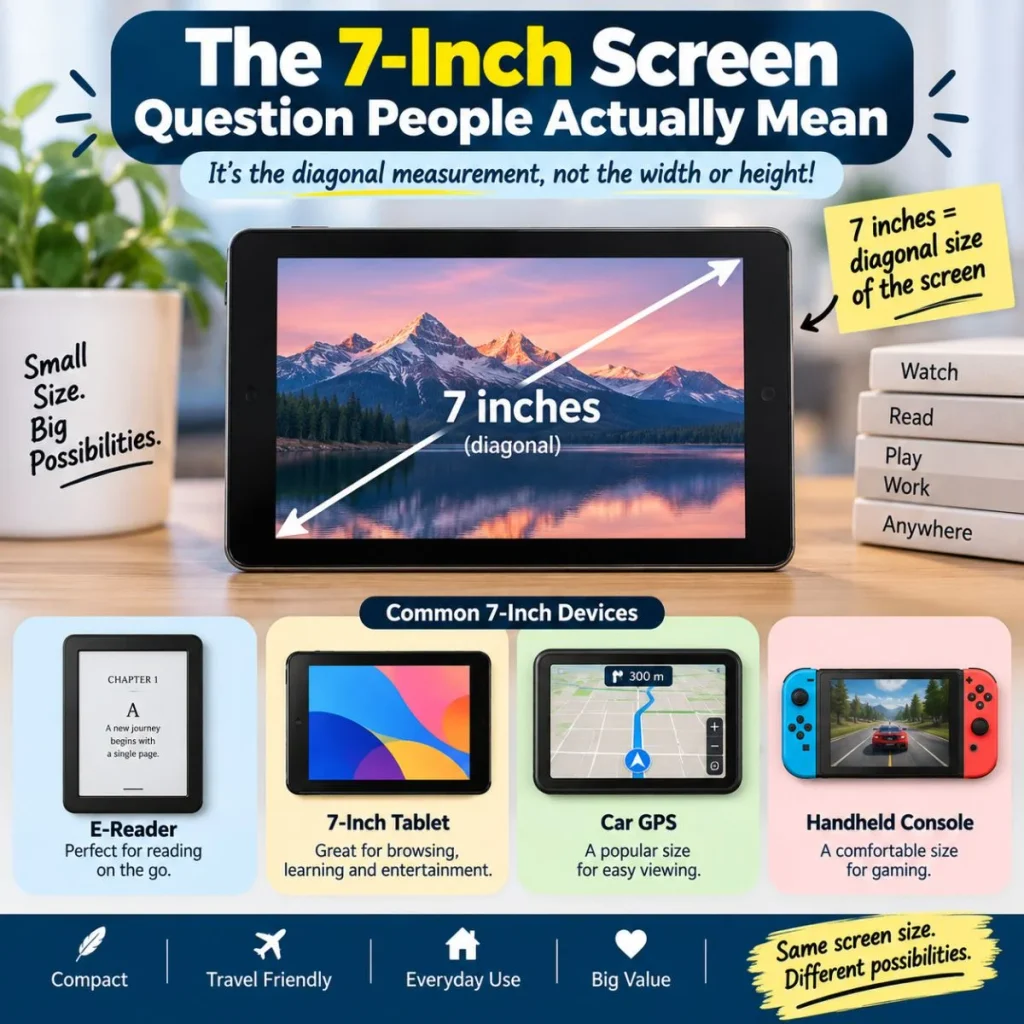
One of the most common reasons people encounter the number 7 inches is when shopping for electronics.
If a product is advertised as having a 7-inch screen, the number normally describes the diagonal measurement of the display.
Imagine a rectangular screen. Draw an imaginary line from its bottom-left corner to its top-right corner. That diagonal is the measurement being described.
It does not mean the screen is 7 inches wide.
How wide is a 7-inch screen?
The answer depends on the screen’s aspect ratio.
For example, a 7-inch display with a 16:9 aspect ratio would have an active display area of approximately:
- 6.10 inches wide
- 3.43 inches tall
- 7 inches diagonally
In metric measurements, that is approximately:
- 15.5 cm wide
- 8.7 cm tall
- 17.78 cm diagonally
A screen with another aspect ratio will have different width and height dimensions even though its diagonal remains 7 inches.
The outside dimensions can be larger still because manufacturers add bezels, frames, buttons, and housing around the display.
So if you are checking whether a 7-inch device will fit into a particular space, do not rely on the screen size alone. Look at the product’s complete width, height, and thickness.
Getting to 7 Inches Without a Tape Measure
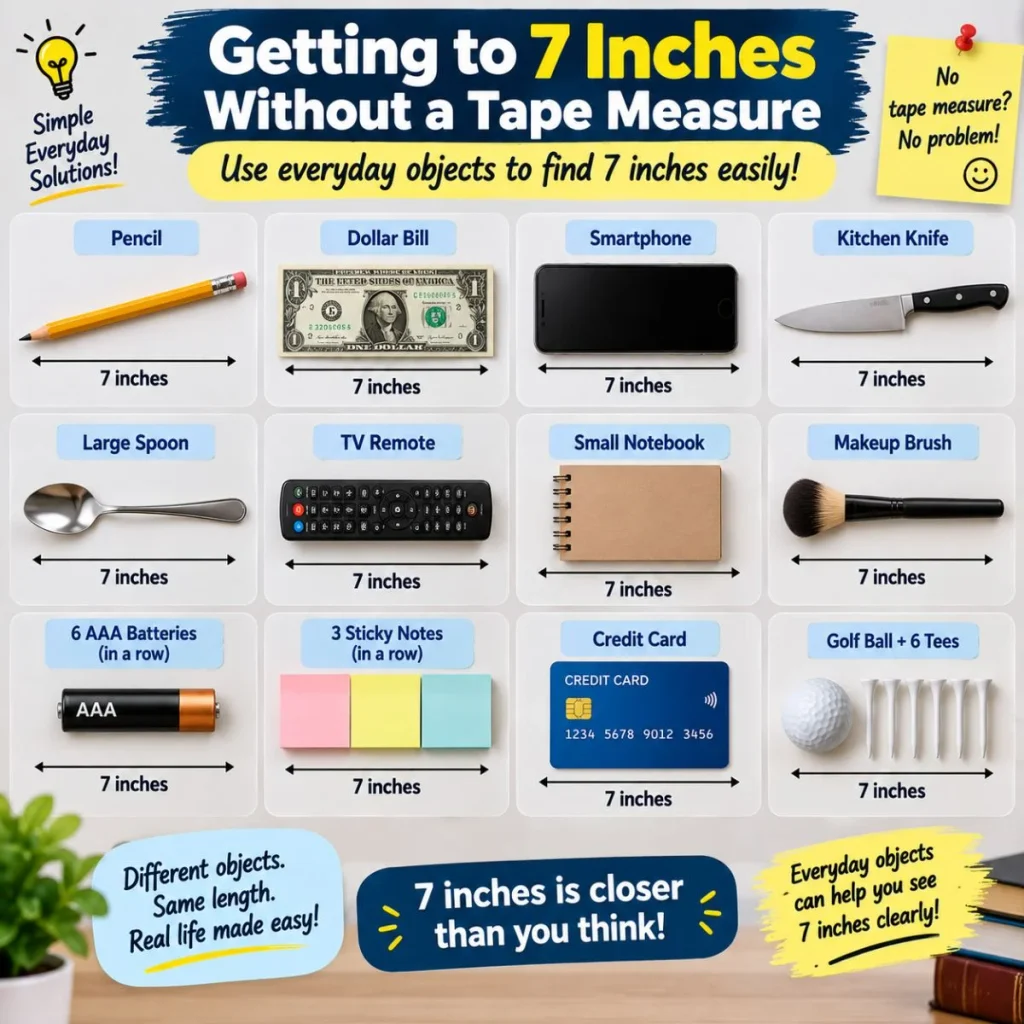
You can get a surprisingly good estimate of 7 inches using familiar objects, although none of these methods should replace a measuring tool when precision matters.
1. Put Two Payment Cards Together
Two typical payment cards measure approximately 6.75 inches when placed end-to-end.
That is very close to 7 inches, with a difference of only about a quarter-inch.
This is probably one of the easiest everyday comparisons because most people have access to a bank, credit, or debit card.
2. Compare It With Letter Paper
The short side of US Letter paper is 8.5 inches.
Seven inches is therefore exactly 1.5 inches shorter.
If you have a sheet of Letter paper nearby, you can use its width as a reference and mentally subtract a small section.
3. Use a Standard Ruler
A ruler remains the best option.
On a 12-inch ruler, locate the zero mark and then find the 7-inch mark. The distance between those two points is exactly 7 inches.
There is no approximation involved.
4. Think in Centimeters
If you normally use metric measurements, remember that:
7 inches = 17.78 cm
For casual purposes, round that to approximately 18 cm.
An 18-cm object will look extremely close to a 7-inch object.
5. Use Your Hand Carefully
Your hand can serve as a personal reference, but it is not standardized.
Hand dimensions vary significantly from person to person, so a measurement that happens to be 7 inches for you may not be 7 inches for someone else.
Use this method only for rough visualization.
[INTERNAL LINK: How Many Inches Are in a Foot?]
FAQs About 7 Inches
How many feet is 7 inches?
Seven inches equals 0.5833 feet, or approximately 0.58 feet. It is a little more than half of a foot.
How many centimeters is 7 inches?
Seven inches equals 17.78 centimeters exactly. For a quick estimate, you can think of it as about 18 cm.
How many millimeters is 7 inches?
Seven inches equals 177.8 millimeters. One inch is exactly 25.4 millimeters.
How many meters is 7 inches?
Seven inches equals 0.1778 meters, which can be rounded to approximately 0.18 meters.
How long is 7 inches?
Seven inches is 17.78 cm long and slightly more than half a foot. Two standard payment cards placed end-to-end are about 6.75 inches, giving you a close everyday comparison.
Is 7 inches considered big?
It depends on the object. Seven inches is fairly substantial for a small household item, but it is a short measurement when compared with furniture, large screens, or human height.
What everyday object is about 7 inches?
A new full-size pencil can be close to 7 inches, while a small banana, compact book, dessert plate, or 7-inch vinyl record can also provide useful comparisons.
Is a 7-inch pizza actually 7 inches wide?
A pizza described as 7 inches normally refers to its approximate diameter. The actual finished pizza may vary slightly depending on how it is prepared.
Is a 7-inch screen 7 inches wide?
No. A 7-inch screen is normally measured diagonally from one corner to the opposite corner. Its actual width and height depend on its aspect ratio.
Can I visualize 7 inches without a ruler?
Yes. Two standard payment cards placed end-to-end are approximately 6.75 inches, which is close to 7 inches. You can also remember that 7 inches is about 18 cm.
What is 7 inches in feet and inches?
Seven inches is 0 feet 7 inches. As a decimal number of feet, it is approximately 0.5833 feet.
What is half of 7 inches?
Half of 7 inches is 3.5 inches, which equals 8.89 centimeters.
Is 7 inches close to 18 cm?
Yes. The exact value is 17.78 cm, so 18 cm is a convenient rounded approximation.
How much shorter than a foot is 7 inches?
A foot contains 12 inches. Therefore, 7 inches is 5 inches shorter than one foot.
How many 7-inch lengths make a foot?
One foot is 12 inches, so 12 ÷ 7 is approximately 1.71. In other words, one full foot is about one and seven-tenths 7-inch lengths.
Where That Leaves You
So, how big is 7 inches? The exact answer is 17.78 centimeters, 177.8 millimeters, 0.1778 meters, or about 0.58 feet.
For a quick mental picture, imagine two standard payment cards placed end-to-end. At roughly 6.75 inches, they come very close to the target. A 7-inch vinyl record gives you another strong visual because its diameter is approximately 7 inches.
The important detail is that 7 inches can describe different dimensions depending on the object. It may represent a length, diameter, width, height, or screen diagonal.
Once you know what dimension is being measured, becomes much easier to picture. If you need precision, use a ruler or measuring tape; if you simply need a mental reference, think about 18 centimeters or just under 6/10 of a foot.