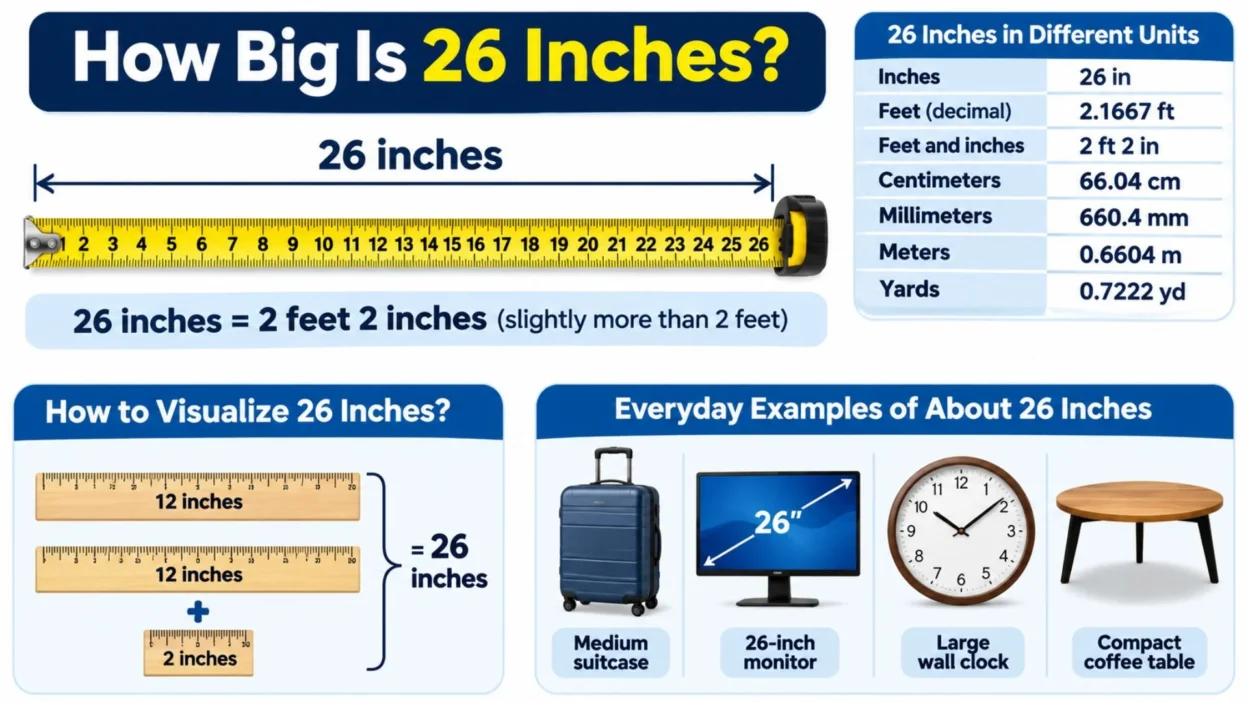
If you are wondering how big is 26 inches, it equals 2 feet and 2 inches, 66.04 centimeters, or 660.4 millimeters. It is slightly longer than two feet and measures approximately 0.66 meters.
To visualize this measurement, imagine placing two standard 12-inch rulers end to end and adding another 2 inches. Together, they give you exactly 26 inches.
However, understanding a measurement becomes easier when you compare it with familiar objects. Whether you are measuring furniture, checking product dimensions, or simply trying to understand how long 26 inches is, this guide explains everything with simple examples, accurate conversions, and practical comparisons.
How Big Is 26 Inches in Different Units?
26 inches can be converted into several commonly used measurement units.
Here is a quick conversion table:
| Measurement Unit | Equivalent |
|---|---|
| Inches | 26 inches |
| Feet | 2.1667 feet |
| Feet and inches | 2 feet 2 inches |
| Centimeters | 66.04 cm |
| Millimeters | 660.4 mm |
| Meters | 0.6604 m |
| Yards | 0.7222 yards |
These conversions are useful when comparing measurements from different countries.
For example, the United States commonly uses inches and feet for everyday measurements. In contrast, Pakistan and many other countries generally use centimeters and meters.
Therefore, knowing both systems makes it easier to understand product dimensions, furniture sizes, and construction measurements.
What Does 26 Inches Look Like?
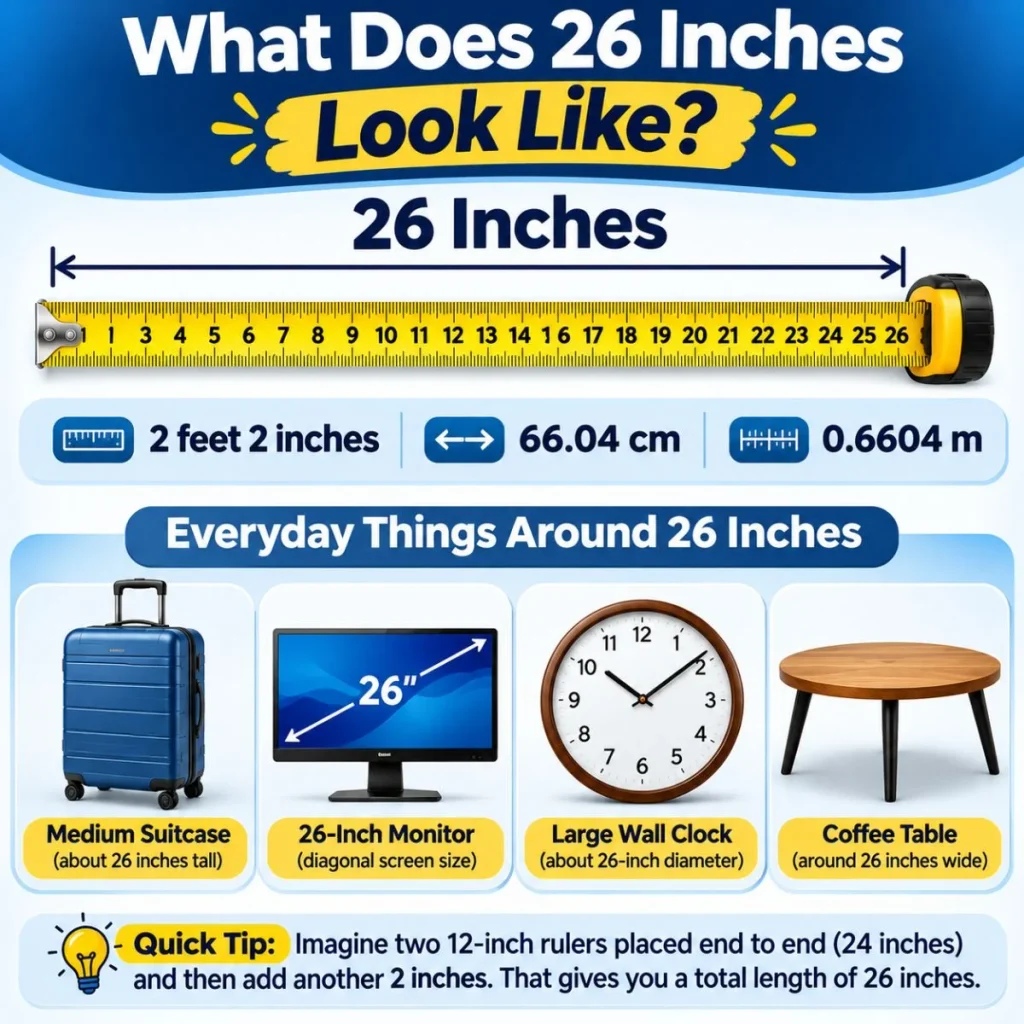
A length of 26 inches is slightly more than two feet.
One simple way to understand it is to imagine a standard 12-inch ruler. Place another 12-inch ruler directly beside it. You now have 24 inches. Add another 2 inches, and the total becomes 26 inches.
Here is another way to understand the measurement:
- 12 inches make 1 foot.
- 24 inches make 2 feet.
- 26 inches make 2 feet and 2 inches.
This means 26 inches extends 2 inches beyond the two-foot mark.
It is a useful reference when measuring household objects, furniture, storage spaces, and other everyday items.
10 Common Things That Are Around 26 Inches Long
Comparing 26 inches with familiar objects can help you develop a better understanding of its size.
The following examples are approximate. Actual dimensions vary by manufacturer, design, and product type.
1. A Medium-Sized Suitcase
Some medium-sized rolling suitcases measure approximately 26 inches in exterior height.
These suitcases are commonly used for vacations and longer trips. However, their actual dimensions can include wheels and handles, depending on the manufacturer’s measurement method.
Therefore, a 26-inch suitcase provides a useful example of this length.
2. A 26-Inch Computer Monitor
A computer monitor advertised as 26 inches has a diagonal screen measurement of 26 inches.
This means the measurement runs from one corner of the visible screen to the opposite corner.
However, the actual width is shorter than 26 inches. For a typical 16:9 screen, the width is approximately 22.7 inches, while the height is around 12.8 inches.
This is an important distinction when checking whether a monitor will fit on your desk.
3. A Large Wall Clock
Some decorative wall clocks have a diameter close to 26 inches.
A clock of this size can become a noticeable feature in a living room, office, or dining area.
Because the diameter measures the distance across a circle through its center, a 26-inch clock extends approximately 13 inches from its center to its outer edge.
4. A Small Coffee Table
Certain compact coffee tables measure approximately 26 inches in length or width.
These tables are useful in smaller living rooms, apartments, and limited spaces.
However, always check the product’s complete dimensions because length, width, and height describe different measurements.
5. A Compact Bookshelf
A small bookshelf measuring 26 inches in height is another practical comparison.
This size can work well for storing books, decorative items, and small household accessories.
Nevertheless, bookshelf dimensions vary considerably depending on the number of shelves and overall design.
6. A Kitchen Countertop Section
A countertop section measuring 26 inches across provides a practical example of this length.
This measurement can be useful when planning kitchen layouts, checking available space, or comparing cabinet dimensions.
For installation projects, always measure the actual available area rather than relying on an approximate comparison.
7. A Small Television
A television with a 26-inch screen has a diagonal measurement of 26 inches.
Although the screen size sounds relatively large, its actual width is approximately 22.7 inches for a 16:9 display.
This is why screen measurements should never be confused with the overall width of a television.
8. A Storage Container
Some large plastic storage containers have one dimension close to 26 inches.
They are commonly used for organizing clothes, toys, household supplies, and other belongings.
However, the height, width, and depth can differ significantly between models.
9. A Small Window
A window measuring 26 inches across provides another useful comparison.
This measurement can help when planning a room layout or checking available wall space.
Keep in mind that window measurements may refer to the frame, glass, or rough opening. These dimensions are not always identical.
10. A Children’s Guitar
Some children’s guitars and compact guitar models have dimensions approaching 26 inches.
However, guitar measurements depend on the instrument’s overall design and scale length.
For this reason, check the manufacturer’s specifications before using guitar dimensions as an exact comparison.
How to Convert 26 Inches Into Feet?
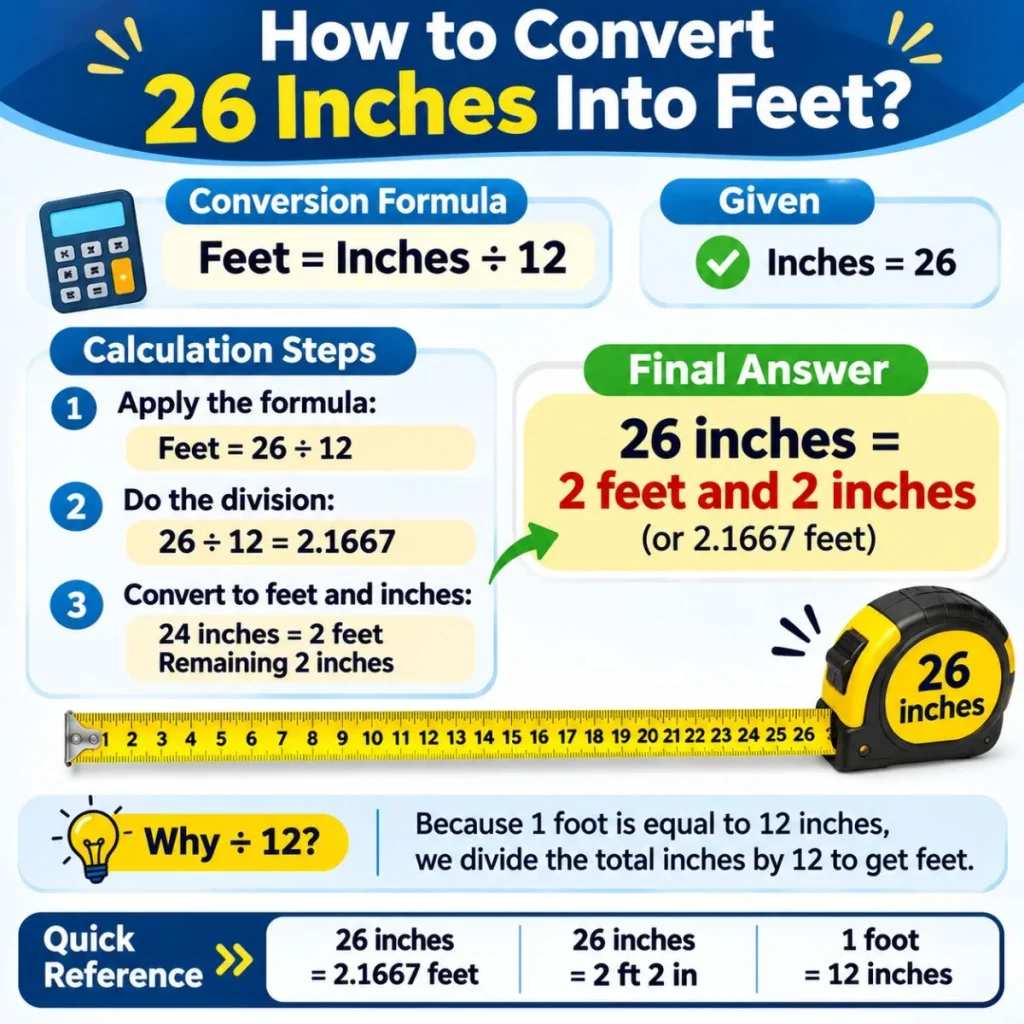
Converting inches into feet is straightforward because one foot contains exactly 12 inches.
Formula:
Feet = Inches ÷ 12
Given:
26 inches
Calculation:
26 ÷ 12 = 2.1667 feet
Therefore:
26 inches = 2.1667 feet (approximately).
You can also express this measurement in feet and inches:
- First, 12 inches equal 1 foot.
- Next, 24 inches equal 2 feet.
- Finally, 2 inches remain.
Final Answer: 26 inches = 2 feet and 2 inches.
This format is particularly useful in construction, furniture planning, and everyday measuring.
How to Convert 26 Inches Into Centimeters?
The metric system uses centimeters to measure shorter lengths.
One inch is defined as exactly 2.54 centimeters. Therefore, converting inches into centimeters requires simple multiplication.
Formula:
Centimeters = Inches × 2.54
Given:
26 inches
Calculation:
26 × 2.54 = 66.04 cm
Final Answer: 26 inches = 66.04 centimeters.
For example, if you are purchasing a product from an American website and its dimensions are listed as 26 inches, you can use 66.04 cm to understand its size in the metric system.
How to Convert 26 Inches Into Millimeters?
Millimeters are smaller than centimeters and are often used for precise measurements.
One inch equals exactly 25.4 millimeters.
Formula:
Millimeters = Inches × 25.4
Calculation:
26 × 25.4 = 660.4 mm
Final Answer: 26 inches = 660.4 millimeters.
This conversion is useful for technical drawings, manufacturing, engineering, and projects that require more precise measurements.
How Big Is 26 Inches Compared to Other Measurements?
Comparing with smaller and larger measurements helps you understand its relative size.
The following table provides some useful reference points.
| Inches | Feet and Inches | Centimeters |
|---|---|---|
| 12 inches | 1 foot | 30.48 cm |
| 15 inches | 1 foot 3 inches | 38.10 cm |
| 18 inches | 1 foot 6 inches | 45.72 cm |
| 20 inches | 1 foot 8 inches | 50.80 cm |
| 22 inches | 1 foot 10 inches | 55.88 cm |
| 24 inches | 2 feet | 60.96 cm |
| 26 inches | 2 feet 2 inches | 66.04 cm |
| 28 inches | 2 feet 4 inches | 71.12 cm |
| 30 inches | 2 feet 6 inches | 76.20 cm |
| 36 inches | 3 feet | 91.44 cm |
| 40 inches | 3 feet 4 inches | 101.60 cm |
As you can see, is:
- 2 inches longer than 24 inches.
- 4 inches shorter than 30 inches.
- 10 inches shorter than 36 inches.
- 2 inches more than 2 feet.
These comparisons make it easier to estimate the measurement without performing complicated calculations.
Is 26 Inches Considered Big?
Whether is considered big depends on the object being measured.
For example, a 26-inch computer monitor is reasonably large for a desktop display. However, a 26-inch dining table would be relatively small for most dining arrangements.
Here are a few practical examples:
| Object | Is 26 Inches Big? |
|---|---|
| Computer monitor | A reasonably large screen |
| Television | A relatively small screen |
| Suitcase | A medium-sized suitcase |
| Coffee table | A compact size |
| Wall clock | A large decorative clock |
| Bookshelf | A small or compact height |
| Kitchen countertop | A useful section length |
Therefore, there is no universal definition of whether is big or small.
The answer depends on the object’s purpose, shape, and intended use.
How to Measure 26 Inches Accurately
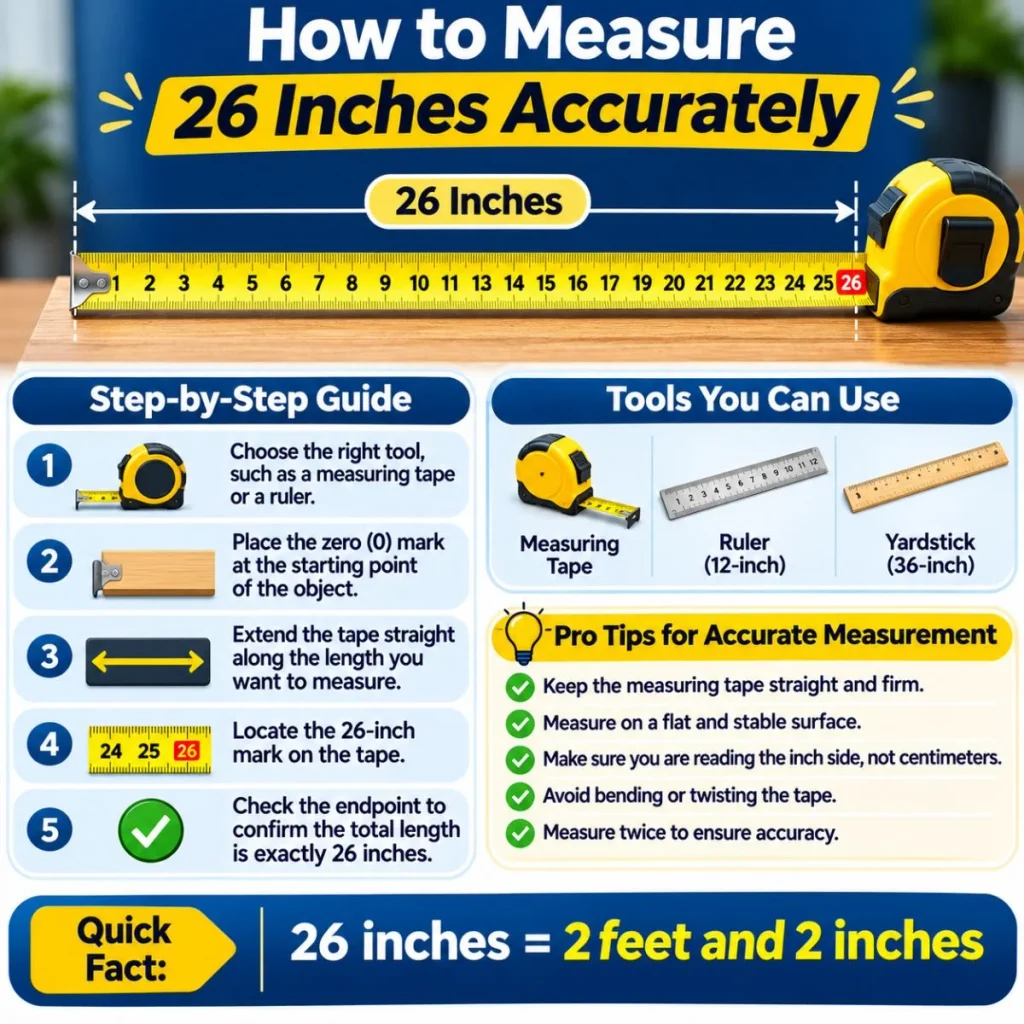
If you want to measure something that is long, you can use a measuring tape, ruler, or yardstick.
Follow these steps to get an accurate result:
- Place the beginning of your measuring tool at the starting point.
- Extend the tape along the direction you want to measure.
- Keep the tape straight without bending or twisting it.
- Locate the 26-inch marking.
- Check the endpoint to confirm the measurement.
For better accuracy, make sure you read the correct side of your measuring tape.
Some measuring tapes display inches on one side and centimeters on the other. Therefore, check the unit before recording your result.
Additionally, remember that length, width, and height describe different dimensions. A measurement of only tells you the size of the particular dimension being measured.
Common Mistakes When Understanding 26 Inches
Although is an easy measurement to convert, several common mistakes can create confusion.
1. Assuming 26 Inches Equals 2.6 Feet
This is incorrect because one foot contains 12 inches, not 10 inches.
The correct calculation is:
26 ÷ 12 = 2.1667 feet.
2. Confusing Screen Size With Screen Width
A 26-inch monitor does not necessarily measure across its width.
Instead, screen size is measured diagonally from one corner to the opposite corner.
This distinction is important when selecting a monitor or television for a particular space.
3. Mixing Inches With Centimeters
Inches and centimeters are different measurement units.
For accurate conversions, always remember:
1 inch = 2.54 centimeters.
Therefore, 26 inches equals 66.04 centimeters, not 26 centimeters.
4. Forgetting the Remaining Inches
When converting inches into feet, some people only consider complete feet.
However, 26 inches contains two complete feet and an additional 2 inches.
Always include the remaining inches when expressing the measurement in feet and inches.
5. Assuming Every Object Has the Same Dimensions
Two objects can both measure in length while having completely different heights and widths.
For example, a 26-inch-long table and a 26-inch-high bookshelf have different dimensions and uses.
Always identify which side or dimension you are measuring.
Frequently Asked Questions
1. How big is 26 inches in feet?
equals approximately 2.17 feet, or exactly 2 feet and 2 It is slightly longer than two feet.
2. How many centimeters are in 26 inches?
equals exactly 66.04 centimeters. Multiply 26 by 2.54 to get the correct conversion.
3. Is 26 inches bigger than 2 feet?
Yes. Two feet equal 2 , so 26 inches is exactly 2 longer than 2 feet.
4. How many millimeters is 26 inches?
equals 660.4 millimeters. You can calculate this by multiplying 26 by 25.4.
5. How many meters is 26 inches?
equals 0.6604 meters. This is approximately two-thirds of a meter.
6. What is half of 26 inches?
Half of is 13 This is equivalent to 1 foot and 1 inch or 33.02 centimeters.
7. Is 26 inches a good monitor size?
Yes. A 26-inch monitor can provide a comfortable viewing area for office work, browsing, and entertainment. However, the best size depends on desk space, viewing distance, and personal preference.
8. How much longer is 26 inches than 24 inches?
is exactly 2 longer than 24 inches. The difference is also equal to 5.08 centimeters.
9. Is 26 inches the same as 66 centimeters?
Not exactly. equals 66.04 centimeters. However, it is very close to 66 centimeters, with a difference of only 0.04 cm.
10. How can I visualize 26 inches without a measuring tape?
Imagine two standard 12-inch rulers placed end to end. They make 24 inches. Adding another 2 gives you the complete 26- measurement.
Conclusion
So, how big is ures exactly 2 feet and 2 inches, which is equivalent to 66.04 centimeters, 660.4 millimeters, or 0.6604 meters.
You can visualize this length by placing two standard 12-inch rulers together and adding another 2 inches. Everyday objects, such as medium-sized suitcases, compact furniture, and large decorative clocks, can also provide useful comparisons.
Whether you are measuring furniture, comparing product dimensions, or converting into metric units, understanding these simple measurements makes it easier to work with accurately.