Have you ever wondered how heavy 100kg really is? Whether you are comparing body weight, lifting objects, checking luggage limits, or trying to understand metric measurements, knowing what 100 kilograms feels like can make the number easier to understand.
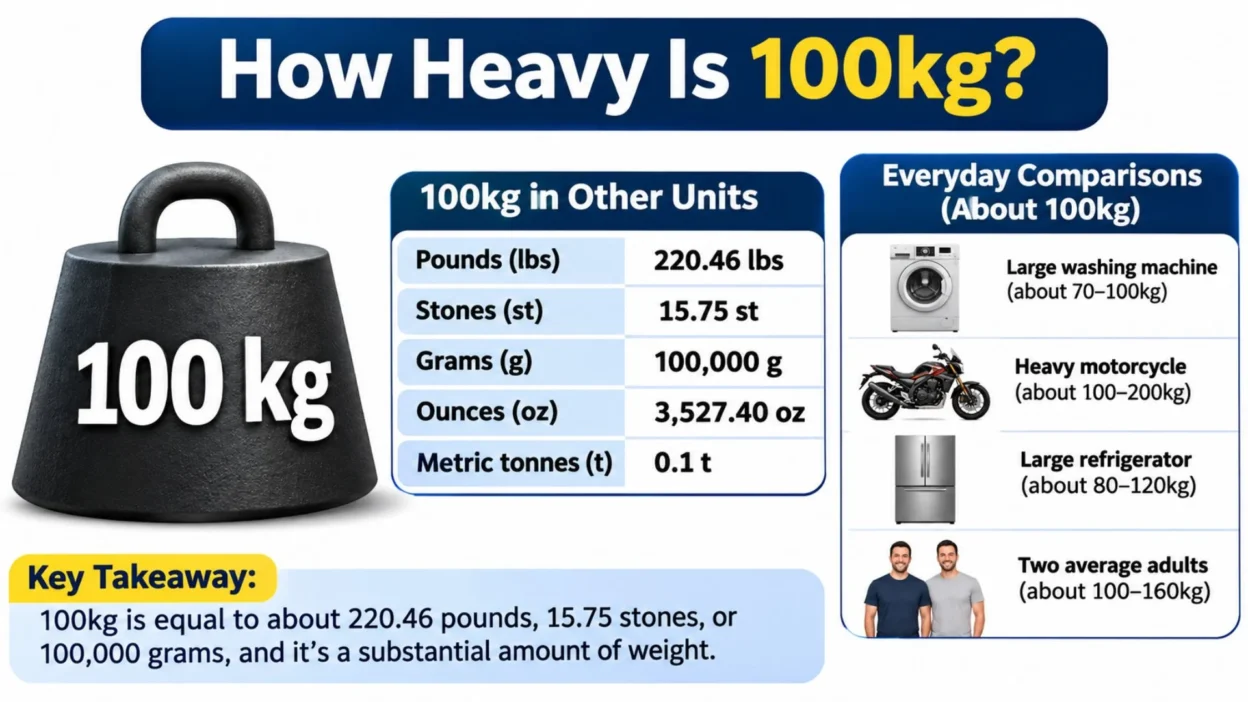
100kg is equal to approximately 220.46 pounds (lbs), 15.75 stone, or 100,000 grams. It is a substantial amount of weight, similar to the combined weight of two average adults or a large household appliance, depending on the comparison.
However, the actual heaviness of an object depends on its size, shape, material, and how its weight is distributed. For example, lifting a compact 100kg metal object can feel very different from moving a large 100kg piece of furniture.
Understanding this measurement is useful in everyday situations, from shopping and transportation to fitness, construction, and shipping. Let’s explore what 100kg means and how it compares with familiar objects.
How Much Is 100kg in Pounds?
100 kilograms equals approximately 220.46 pounds. This conversion is useful for people who are more familiar with the imperial measurement system.
To convert kilograms into pounds, multiply the kilogram value by 2.20462.
Formula:
Kilograms × 2.20462 = Pounds
Calculation:
100 × 2.20462 = 220.462 pounds
Final answer: 100kg = 220.46 pounds.
This means an object weighing 100kg is slightly heavier than 220 pounds. If you see a product listed as 100kg, you can think of it as approximately 220 pounds to understand its weight more easily.
What Does 100kg Look Like in Everyday Life?
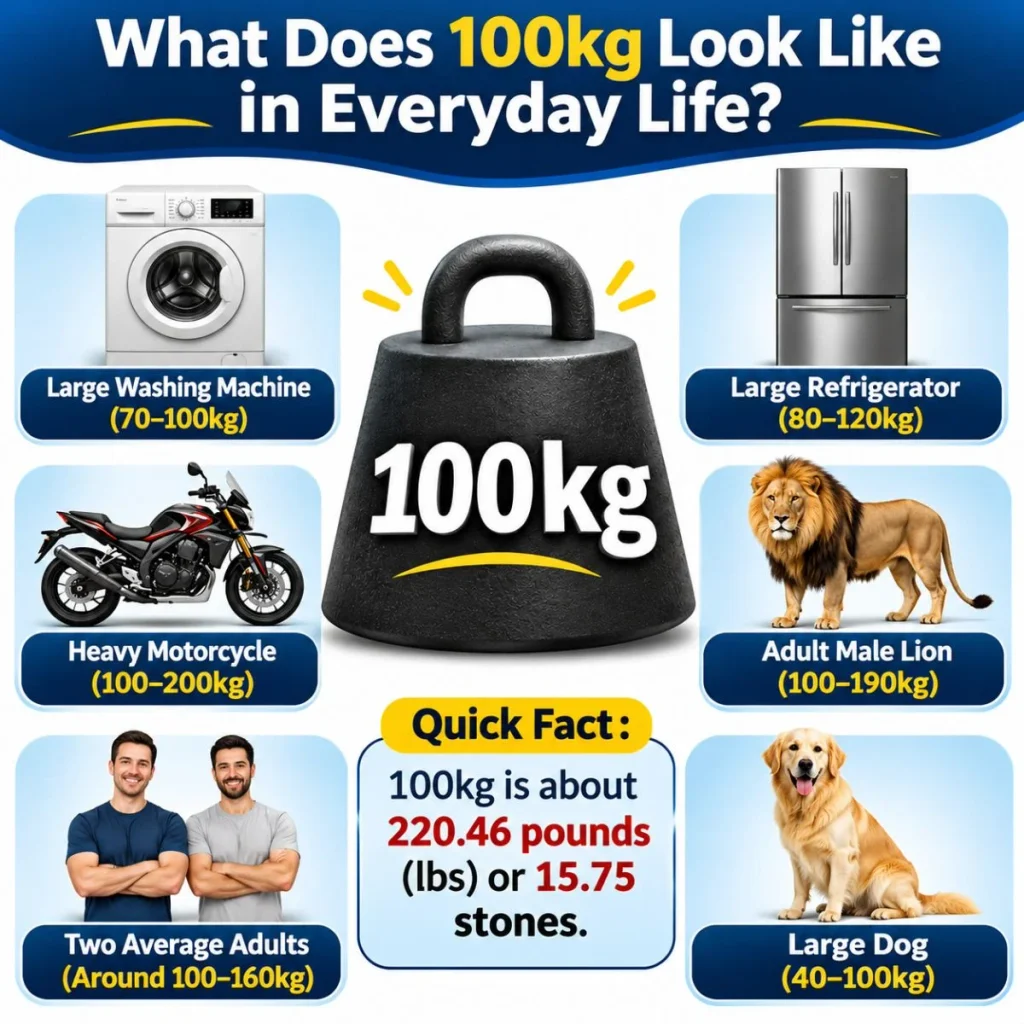
Numbers can sometimes be difficult to imagine without familiar comparisons. Fortunately, several everyday objects can help you understand how heavy 100kg is.
Here are some approximate examples:
| Everyday object | Approximate weight |
|---|---|
| Adult male lion | 100–190kg |
| Large washing machine | 70–100kg |
| Two average adults | Around 100–160kg |
| Large refrigerator | 80–120kg |
| Heavy motorcycle | 100–200kg |
| Large dog | 40–100kg |
| Commercial weightlifting barbell setup | 100kg |
These examples are estimates, not fixed measurements. Actual weights vary depending on the model, breed, size, and manufacturer.
For instance, a washing machine with a weight of 100kg can give you a practical idea of how much 100 kilograms represents. Similarly, a motorcycle weighing around 100kg provides another familiar comparison.
How Heavy Is 100kg Compared to a Person?
When discussing human body weight, 100kg is equivalent to approximately 220.46 pounds.
For someone who uses pounds, this conversion makes the measurement easier to understand.
However, body weight alone does not tell you everything about a person’s health or physical condition. Height, muscle mass, body composition, age, and other factors also matter.
For example:
- A person weighing 50kg is half as heavy as 100kg.
- A person weighing 75kg is 25kg lighter than 100kg.
- A person weighing 90kg is 10kg lighter than 100kg.
- A person weighing 110kg is 10kg heavier than 100kg.
- A person weighing 120kg is 20kg heavier than 100kg.
These comparisons are useful when understanding weight differences without repeatedly converting between measurement systems.
How Heavy Is 100kg in Stones?
The stone is another unit used to measure human body weight, particularly in the United Kingdom and Ireland.
One stone equals 6.35029 kilograms.
To convert 100kg into stones, divide the kilogram value by 6.35029.
Calculation:
100 ÷ 6.35029 = 15.7479 stones.
Therefore, 100kg is approximately 15.75 stones.
This is also expressed as approximately 15 stone and 10.5 pounds.
The stone measurement is particularly helpful when comparing body weights because many people in the UK prefer discussing their weight in stones and pounds rather than kilograms.
How Heavy Is 100kg in Other Units?
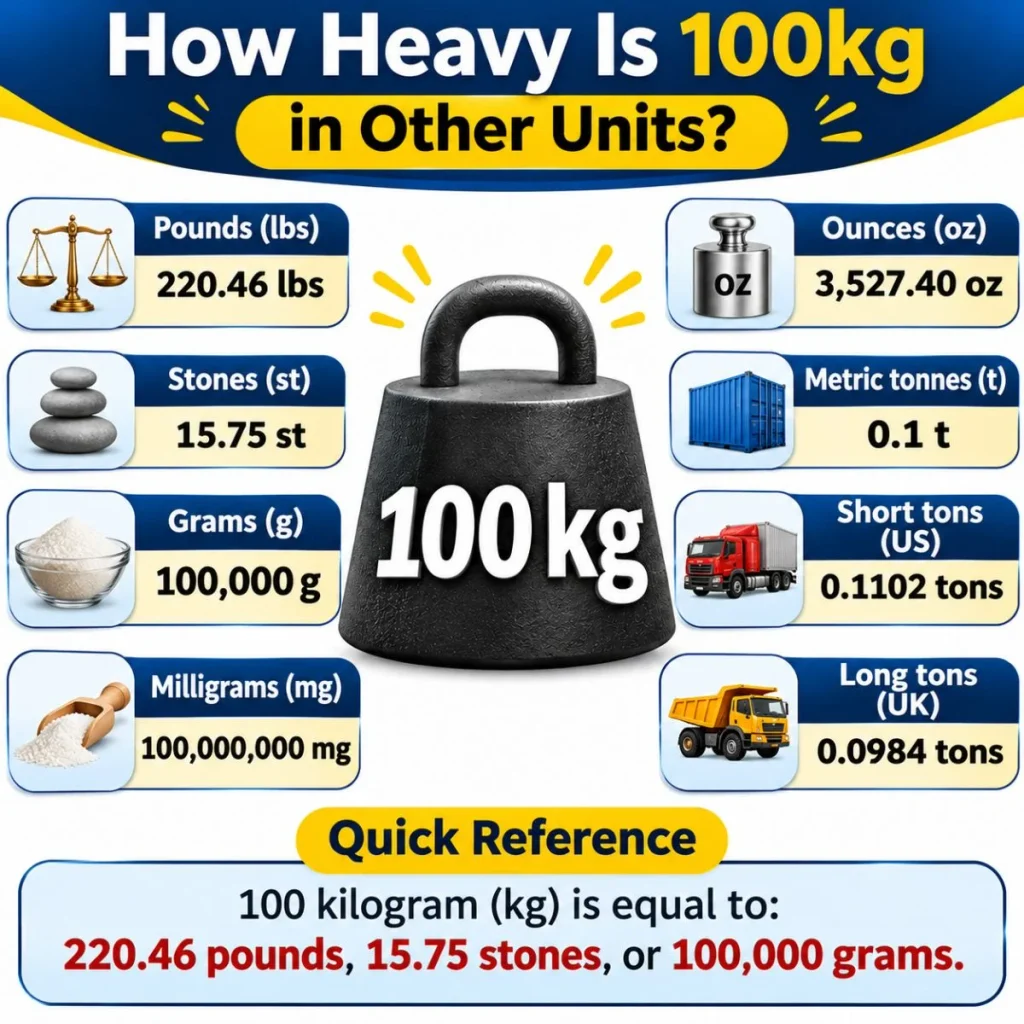
Kilograms can be converted into several different measurement units. These conversions are useful for international shipping, engineering, transportation, fitness, and everyday calculations.
Here is a quick conversion table:
| Measurement unit | Equivalent of 100kg |
|---|---|
| Grams | 100,000g |
| Milligrams | 100,000,000mg |
| Pounds | 220.46lbs |
| Ounces | 3,527.40oz |
| Stones | 15.75 stones |
| Metric tonnes | 0.1 tonnes |
| Short tons (US) | 0.1102 tons |
| Long tons (UK) | 0.0984 tons |
These values are rounded to make them easier to read.
For example, if you are purchasing a product that weighs 100kg, you can use the table to understand its weight in different measurement systems without performing the calculations yourself.
Is 100kg Heavy to Lift?
Yes, 100kg is generally considered a heavy load for most people to lift manually. However, whether someone can lift it depends on their strength, training experience, lifting technique, and physical condition.
A trained weightlifter may be able to lift 100kg using the appropriate technique. On the other hand, someone without weightlifting experience may find even a much lighter load difficult to handle safely.
The type of lifting also makes a difference.
For example:
- Deadlift: A trained person may lift 100kg from the floor using proper technique.
- Squat: Lifting 100kg on the shoulders requires considerable strength and balance.
- Overhead press: Moving 100kg above the head is much more demanding.
- Carrying: Walking while carrying 100kg can be extremely challenging and potentially unsafe.
It is important to remember that lifting ability is not the same for everyone. Proper equipment, training, and assistance can reduce the risk of injury.
How Much Force Does a 100kg Object Have?
In everyday language, people use kilograms to describe how heavy something is. Scientifically, however, kilograms measure mass rather than force.
Mass describes how much matter an object contains, while weight is the gravitational force acting on that mass.
On Earth, an object with a mass of 100kg experiences a gravitational force of approximately 980.665 newtons.
The formula is:
Weight = Mass × Gravitational Acceleration
Using standard Earth gravity:
100 × 9.80665 = 980.665 newtons.
Therefore, a 100kg object has a weight of approximately 981 newtons under standard Earth gravity.
This distinction becomes important in physics and engineering because the mass remains the same when an object moves to another planet, but its weight changes according to local gravity.
Would 100kg Weigh the Same on the Moon?
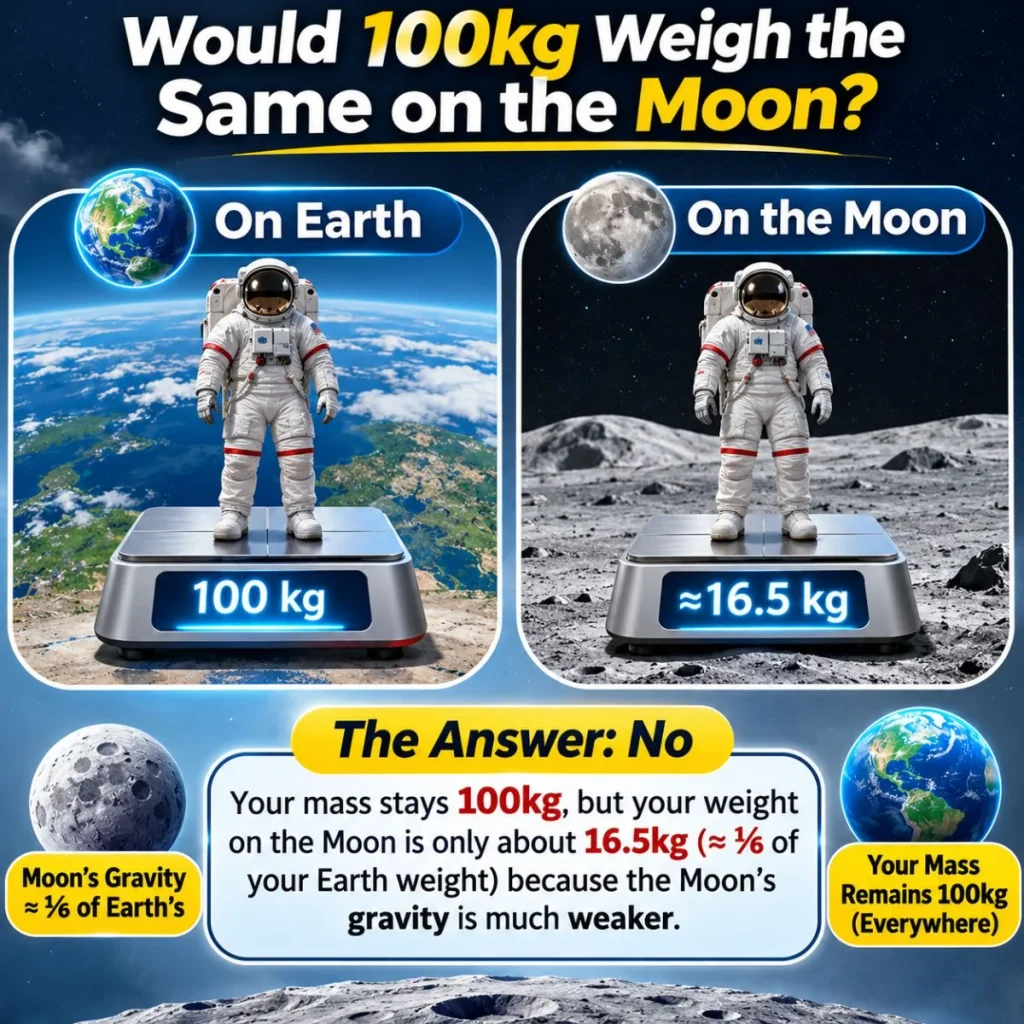
No. An object with a mass of 100kg would weigh much less on the Moon than it does on Earth.
The Moon has approximately one-sixth of Earth’s surface gravity. Therefore, an object with a mass of 100kg experiences a gravitational force of approximately 162 newtons on the Moon.
Its mass remains 100kg, but its weight changes.
Here is a simple comparison:
| Location | Mass | Approximate weight force |
|---|---|---|
| Earth | 100kg | 980.7N |
| Moon | 100kg | 162N |
| Mars | 100kg | 371N |
| Jupiter | 100kg | 2,479N |
These values use approximate surface gravity figures.
This is why astronauts can move more easily on the Moon while handling equipment that would be much harder to lift on Earth.
How Much Space Does 100kg Take Up?
The physical size of a 100kg object depends on the material from which it is made.
For example, 100kg of feathers takes up much more space than 100kg of iron because feathers have a much lower density.
Density describes how much mass is packed into a given volume.
For a practical example:
- 100kg of water occupies approximately 100 liters.
- 100kg of iron occupies approximately 12.7 liters.
- 100kg of feathers can occupy a very large volume depending on how tightly they are packed.
This demonstrates an important point: two objects can have exactly the same mass while looking completely different in size.
Therefore, 100kg does not represent a specific physical size. It only tells you how much mass an object contains.
How Much Is 100kg in Everyday Activities?
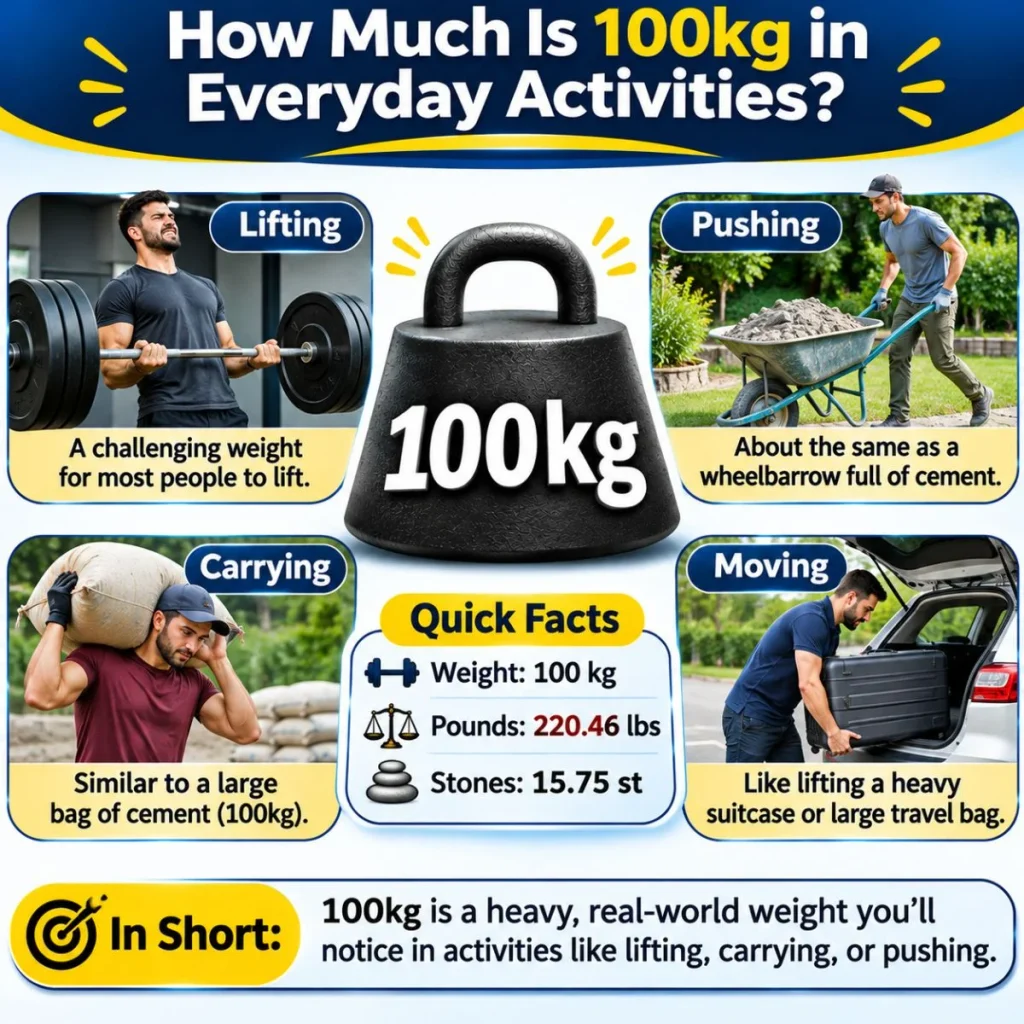
Understanding 100kg can help in several practical situations.
Shipping and transportation: A package weighing 100kg is considered a heavy shipment. You may need special handling equipment, depending on its dimensions and transportation requirements.
Fitness and weightlifting: A 100kg barbell load represents a substantial amount of resistance. Its difficulty depends on the exercise and the person’s training level.
Construction: Materials such as cement, steel, and sand are frequently measured in kilograms. Knowing what 100kg represents can help when estimating material requirements.
Household appliances: Some large appliances can approach or exceed 100kg. Checking the manufacturer’s specifications is important before moving or installing them.
Agriculture: Bags of animal feed, grain, and other agricultural materials may be sold in large quantities. A 100kg quantity is useful for understanding bulk purchases.
Common Mistakes When Understanding 100kg
People sometimes confuse different measurement units when comparing weights. A few simple distinctions can prevent mistakes.
- Kilograms and pounds are different: 100kg is approximately 220.46 pounds, not 100 pounds.
- Mass and weight are not identical: Kilograms measure mass, while newtons measure force.
- 100kg does not mean 100 liters: This is only approximately true for water under ordinary conditions.
- Weight does not determine size: A small metal object and a large collection of feathers can have the same mass.
- Conversion results may be rounded: Using 220.46 pounds instead of 220.462 pounds is a rounded value, not an error.
Understanding these differences makes weight measurements easier to interpret in everyday and technical situations.
Frequently Asked Questions
Is 100kg equal to 200 pounds?
No. 100kg is approximately 220.46 pounds. It is about 20.46 pounds heavier than 200 pounds.
Is 100kg considered heavy?
Yes, 100kg is a substantial amount of mass. It is heavy for many everyday lifting and carrying activities, although trained individuals may handle this weight in certain exercises.
How many pounds are in 100kg?
There are approximately 220.46 pounds in 100kg.
How many grams are in 100kg?
100kg equals 100,000 grams because one kilogram contains 1,000 grams.
How many stones is 100kg?
100kg is approximately 15.75 stones, or 15 stone and 10.5 pounds.
Is 100kg heavier than 100 liters of water?
Not under ordinary conditions. Approximately 100 liters of fresh water has a mass of 100kg at standard reference conditions. However, the exact value can vary slightly with temperature and pressure.
Can an average person lift 100kg?
Some people can lift 100kg, but it depends on their strength, experience, technique, and the type of lift. It should not be assumed that everyone can safely lift this amount.
What is half of 100kg?
Half of 100kg is 50kg, which is approximately 110.23 pounds.
What is 100kg in metric tonnes?
100kg equals 0.1 metric tonnes because one metric tonne contains 1,000 kilograms.
Does 100kg weigh less on the Moon?
Yes. Its mass remains 100kg, but its gravitational weight is approximately one-sixth of its Earth weight.
Conclusion
So, how heavy is 100kg? It is equal to approximately 220.46 pounds, 15.75 stones, or 100,000 grams. This makes it a substantial measurement that can be understood through familiar comparisons, such as heavy household appliances, motorcycles, and combined human body weight.
Understanding this conversion is useful for everyday activities, including fitness, shipping, construction, transportation, and shopping. Remember that kilograms measure mass, while actual weight as a force depends on gravity. Once you understand this difference, comparing 100kg with other measurements becomes much easier.